Best Practices for Using AI and LLMs in Commodity Trading Companies: 2026-2027 Playbook
Key Takeaways
- AI ROI in commodities is data-bound: fix plumbing before models.
- Document intelligence and reconciliation remain the highest-ROI production use case.
- Agentic AI: monitor and alert in 2026; do not auto-execute money-moving workflows.
- General LLMs fail on commodity docs—use domain tools or rigorous prompt + review gates.
- Structured freight procurement is the prerequisite for freight AI and carrier scoring.
What actually works, what still fails, and how to build a competitive edge with AI in physical commodity trading
Who this is for: Trading managers, COOs, and technology leads at physical commodity trading companies who want a clear-eyed view of where AI delivers real returns in 2026—and where it is still mostly hype.
The State of AI in Commodity Trading: 2026 Reality Check
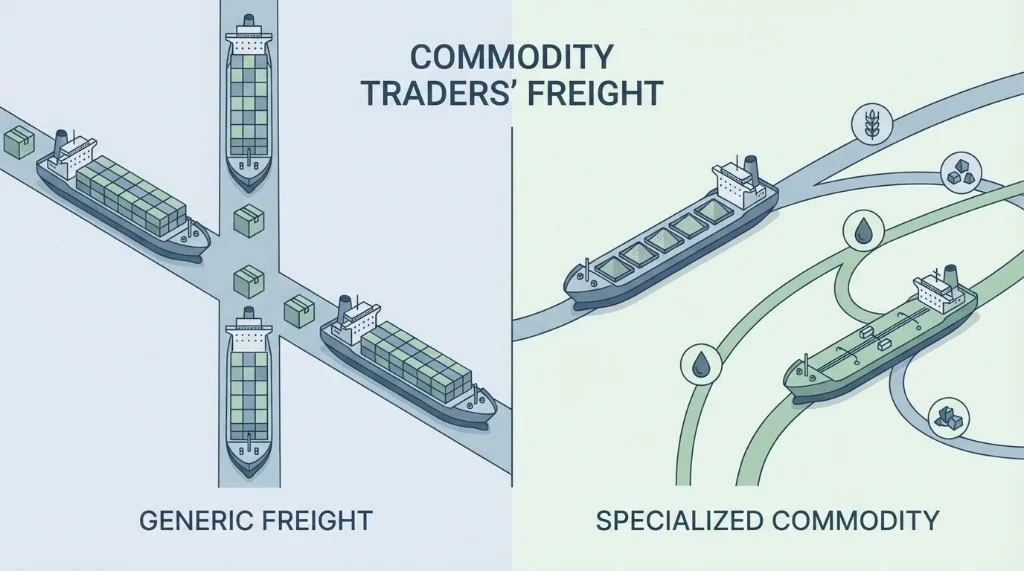
The hype cycle for AI in commodity trading peaked in 2024. What followed was a painful but necessary correction: firms that had invested in generic AI tools discovered that large language models trained on general internet data perform poorly on commodity-specific workflows. A model that can write a marketing email cannot reliably extract pricing terms from a non-standard coal confirmation. A chatbot that summarizes news cannot reconcile a laytime statement against a statement of facts.
The firms that are winning with AI in 2026 are not the ones that deployed the most tools. They are the ones that understood a fundamental principle early: AI in commodity trading is only as good as the data it operates on, and commodity trading data is structurally different from every other industry.
Commodity trading data is non-linear. It is high-volume. It is deeply tethered to physical reality—vessel positions, port congestion, weather events, quality specifications, laytime calculations. It arrives in dozens of unstructured formats from counterparties who have no incentive to standardize. Standard AI methodologies break down on this data. Models built for general enterprise use fail on commodity-specific documents and workflows.
The firms that recognized this distinction—and invested in domain-specific AI built by people who understand commodity operations—are now pulling measurably ahead. Here is what they are doing. For the full five-layer IT context, see our bulk commodity trader technology stack guide; for maritime voyage systems alongside procurement, see freight software for shipping companies (IMOS & specialists).
| Topic | Generic AI assumption | Commodity operations reality |
|---|---|---|
| Documents | One clean PDF schema | 50–200 docs / trade; layouts vary by counterparty |
| Language | General English | CP clauses, index lags, quality penalties, trade jargon |
| Ground truth | Text only | AIS, NOR, SOF, labs, ports, weather—physical tether |
| Risk | Low-stakes summarization | Settlement & credit errors cost seven figures |
The Six AI Use Cases That Deliver Real ROI Today
| # | Use case | Primary KPI | Prerequisite |
|---|---|---|---|
| 1 | Document intelligence | Reconciliation accuracy; time-to-post | CTRM positions + doc store |
| 2 | Contract LLM review | % non-standard clauses caught pre-sign | Risk checklist + corpus |
| 3 | Agentic operations monitoring | Alert precision (signal vs noise) | Streaming ops data + triggers |
| 4 | Market intelligence synthesis | Coverage of sources; structured extracts | Ingestion + warehouse |
| 5 | Counterparty / credit intel | Early-warning lead time | Payment + news + market feeds |
| 6 | Freight rate intelligence | Benchmark error vs realized fixtures | Structured freight data |

1. Document Intelligence — The Highest-ROI Application in the Market
A single bulk commodity trade generates between 50 and 200 documents across its lifecycle. Trade confirmations. Bills of lading. Letters of credit. Quality and quantity certificates. Notice of readiness. Statement of facts. Freight invoices. Demurrage claims. Customs declarations.
Every one of these documents contains structured commercial data locked in an unstructured format. Every one arrives from a different counterparty in a different layout with different terminology for the same concepts. And every one needs to be read, validated, reconciled against your CTRM position, and actioned—often within hours of receipt.
Before AI, this was a manual process. A skilled operations analyst would read each document, extract the relevant data points, check them against the trade record, and flag discrepancies. The process was slow, expensive, and—critically—it generated no structured data that could be analyzed for patterns.
What AI document intelligence changes:
AI systems combining OCR, NLP, and domain-trained LLMs can now process commodity trade documents with production-grade reliability. The practical capabilities in 2026:
- Extract pricing terms, delivery conditions, quality specifications, and laytime terms from trade confirmations in any format—automatically, in seconds
- Reconcile extracted data against CTRM positions and flag discrepancies before settlement
- Identify contract modifications that shift commercial risk—a changed force majeure clause, an altered pricing formula, a modified quality tolerance
- Process bills of lading against letters of credit to validate compliance before presentation
- Match invoice line items against contract terms and flag overbilling automatically
The Freepoint Energy case remains the clearest demonstration of what this capability unlocks at scale. AI document analysis across hundreds of shipments revealed that specific counterparties were consistently invoicing for demurrage when other firms making deliveries at the same facility before and after them were not. That pattern—invisible to any human reviewer working document by document—was immediately apparent to AI analyzing the full dataset. The result: refunds for past overcharges and permanently renegotiated terms going forward.
Best practice for implementation:
Start with trade confirmations and freight invoices—the highest volume, highest risk documents in most commodity trading operations. Implement AI extraction first, then layer reconciliation logic on top once you have confidence in extraction accuracy. Do not attempt to automate exception resolution until extraction and reconciliation are running cleanly.
2. LLMs for Contract Analysis and Risk Flagging
Commodity trading contracts are complex. Pricing formulas reference multiple indices with different publication schedules and averaging periods. Quality specifications carry financial consequences that vary by counterparty and destination. Laytime clauses determine who bears demurrage risk. Force majeure definitions vary materially between counterparties. Governing law and arbitration clauses affect how disputes are resolved.
In most mid-size trading firms, contract review is done by experienced operations staff who have developed pattern recognition over years of reading similar contracts. They catch most issues. They miss some. And they generate no structured record of what they reviewed or what they flagged.
What LLMs change:
Modern LLMs fine-tuned on commodity contract corpora can:
- Review contract drafts against a defined checklist of commercial risk factors in minutes
- Flag non-standard clauses that deviate from your firm’s standard terms
- Extract and structure all pricing formula components for validation against your CTRM setup
- Compare laytime terms against your historical demurrage exposure by route and terminal
- Identify ambiguous language that could support multiple interpretations in a dispute
One commodity trader using AI contract monitoring caught ambiguous terms in a distillers dried grains contract before the cargo reached its Asian buyers. The price of DDGs fell sharply while the cargo was in transit. Any contractual ambiguity could have given the buyer grounds to renegotiate. The AI flagged the issue. The contract was tightened. The revenue was protected.
Best practice for implementation:
Do not deploy a general-purpose LLM for contract review. The failure rate on commodity-specific terminology is too high. Use either a commodity-specific solution (ClearDox, CommodityAI) or a general LLM with a carefully engineered prompt system that includes your firm’s specific contract standards, risk thresholds, and commodity-specific terminology. Build a human review step for all flagged items—AI identifies the risk, humans make the decision.
3. Agentic AI for Operations Monitoring
The most significant development in commodity trading AI between 2025 and 2026 is the maturation of agentic AI—systems that do not just analyze data when asked, but continuously monitor operational data streams and take defined actions when specific conditions are met.
Gartner identified Agentic AI as the top enterprise technology trend for 2026. In commodity trading operations, the practical applications that are production-ready today:
Vessel arrival monitoring agents: Instead of operations staff manually tracking every vessel arrival notification and comparing it against pricing dates and laytime calculations, an AI agent does this continuously. It monitors AIS data from Kpler or MarineTraffic, compares vessel positions against expected arrival windows, and sends alerts only when there is a genuine issue—a vessel running significantly late relative to a pricing date, a port congestion event that threatens a laycan, a notice of readiness received outside the contractual window.
Settlement instruction validation agents: Before a settlement instruction is sent, an AI agent validates it against the underlying contract terms—pricing formula, payment timing, bank details, currency. Discrepancies are flagged for human review before execution, not after.
Invoice discrepancy agents: AI agents monitor incoming invoices against contract terms continuously, flagging overbilling, incorrect pricing formula applications, and unauthorized charges before payment is made.
The critical design principle for agentic AI in trading: Agents that monitor and alert are production-ready in 2026. Agents that execute autonomously on financial transactions are not, and should not be treated as if they are. The liability exposure and the current reliability limitations both argue for maintaining human oversight on any action that affects a live position or a financial transaction.
Best practice for implementation:
Define the specific trigger conditions for each agent before deployment. “Monitor vessel arrivals” is not a sufficient specification. “Alert when a vessel’s AIS position indicates arrival will be more than 12 hours after the contractual NOR window, and the cargo has a pricing date tied to bill of lading date” is. Precision in agent design determines whether you get useful alerts or noise.
4. Market Intelligence Synthesis with LLMs
Physical commodity traders consume enormous volumes of market intelligence daily—price assessments from Platts and Argus, freight market reports from the Baltic Exchange, supply and demand analysis from Kpler and Vortexa, weather forecasts, port congestion reports, regulatory updates across multiple jurisdictions.
Most of this intelligence arrives in text format. Most of it is read by individual traders who extract the parts relevant to their specific positions and discard the rest. There is no systematic synthesis across sources, no structured capture of the insights extracted, and no way to query the collective market intelligence your team has consumed over time.
What LLMs change:
LLMs can now synthesize market intelligence across sources at a speed and scale no human team can match:
- Daily briefings synthesized from 20–30 market reports, structured by commodity class, route, and time horizon
- Automatic extraction of price-relevant data points from text reports into structured formats that feed directly into your data warehouse
- Cross-source signal detection—identifying when multiple independent sources are reporting the same emerging trend before it is reflected in prices
- Historical query capability—“What were the key supply-side factors affecting Pacific Basin coal freight in Q3 2024?” answered from your accumulated intelligence corpus in seconds
Best practice for implementation:
Build a structured intelligence corpus before you build query capability. Implement automated ingestion of your key market intelligence sources into a searchable data store. Use LLMs to extract structured data points (price levels, volume figures, named entities, sentiment signals) from incoming reports automatically. Only then build the synthesis and query layer on top. The query layer is only as good as the corpus it queries.
5. Counterparty and Credit Risk Intelligence
For commodity traders running long-dated offtake agreements, prepayment structures, or significant open credit exposure, early warning on counterparty distress is among the most valuable capabilities AI can provide.
The challenge: counterparty risk signals are distributed across multiple sources—financial filings, credit agency reports, payment behavior in your own systems, news and regulatory filings, market signals like credit spreads and equity prices for public counterparties. No human analyst can monitor all of these sources continuously for all of your counterparties.
What AI changes:
AI agents can monitor counterparty risk signals continuously and surface early warning indicators that would otherwise be missed:
- Payment behavior deterioration in your own systems—slower payments, partial payments, payment disputes—detected and flagged before they reach crisis levels
- News and regulatory monitoring for counterparty names, flagging material events (regulatory investigations, key management departures, credit rating changes, covenant breaches)
- Cross-counterparty pattern detection—identifying when multiple counterparties in the same geography or sector are showing simultaneous stress signals
- Credit spread monitoring for public counterparties with automatic alerts when spreads widen beyond defined thresholds
Best practice for implementation:
Tier your counterparties by exposure level and implement monitoring intensity accordingly. Your top 20 counterparties by credit exposure should have comprehensive AI monitoring across all signal types. Your broader counterparty list can be monitored with lighter-touch automated alerts on news and payment behavior. Integrate AI credit signals into your existing credit committee process—AI provides the data, humans make the credit decisions.
6. Freight Rate Intelligence and Procurement Optimization

Every freight fixture your firm executes generates a data point: the route, the vessel type, the cargo size, the rate, the market context at the time of fixing, the carrier, and the ultimate performance outcome. Most firms capture almost none of this data in structured form.
AI applied to structured freight procurement data enables capabilities that are genuinely transformative for commodity traders:
- Rate benchmarking in real time: Is the rate you are being quoted above or below market? AI models trained on your fixture history plus Baltic Exchange indices and broker assessments can answer this question in seconds, for any route and vessel type in your trading portfolio.
- Optimal timing signals: Freight markets are cyclical and volatile. AI models that combine your historical fixture data with supply-demand signals from Kpler and Vortexa can identify periods when rates are likely to soften, enabling more intelligent timing of fixtures relative to market cycles.
- Carrier performance scoring: Which owners and operators consistently deliver on time? Which brokers consistently bring competitive rates versus which ones are padding margins? Structured data from digital tendering platforms makes these questions answerable with data rather than intuition.
- Route-specific pattern detection: Certain routes, seasons, and cargo types generate disproportionate demurrage. AI trained on your operational data can identify these patterns and flag them proactively in deal structuring.
Best practice for implementation:
The prerequisite for all of these capabilities is structured freight data. This means running freight procurement through a digital tendering platform—not email—so that every fixture generates a structured, comparable data record. Without this foundation, freight AI has nothing clean to work with. The data infrastructure investment comes first. The AI capabilities compound on top of it. FreightTender is built to produce that foundation for commodity and chemical desks.
The Three Failure Modes to Avoid
Understanding where AI fails in commodity trading is as important as understanding where it succeeds.
| Mode | What goes wrong | Fix |
|---|---|---|
| 1. Generic AI on commodity data | High error rate on confirmations & CP language | Domain tools; fine-tuning; strict review gates |
| 2. AI before data structure | Models on inbox + PDF sprawl | Digital tendering, doc automation, warehouse first |
| 3. Removing humans too early | Settlement / credit incidents | Augment → alert → prove reliability → expand |
Failure Mode 1: Deploying general AI on commodity-specific data
The most common and most expensive mistake. General-purpose LLMs perform poorly on commodity trade documents, contracts, and operational workflows. The terminology is specialized. The document formats are non-standard. The business logic is complex and domain-specific. Firms that deploy ChatGPT or a generic document AI on their trade confirmation processing discover this quickly—and expensively.
The solution: use AI tools built specifically for commodity operations by people who understand commodity operations, or invest in proper domain-specific fine-tuning and prompt engineering before deploying general models on production workflows.
Failure Mode 2: Building AI on unstructured data
AI cannot generate reliable insights from data that lives in email threads, PDF attachments, and Excel files scattered across shared drives. Firms that invest in AI analytics before fixing their data infrastructure consistently fail to generate the returns they projected.
The solution: fix the data plumbing first. Implement structured data capture at every operational touchpoint—digital tendering for freight, document automation for trade documents, integrated vessel tracking for cargo monitoring. Build the data warehouse. Then build the AI layer on top of clean, structured data.
Failure Mode 3: Removing human oversight too early
The pressure to reduce headcount by replacing human judgment with AI automation is real and understandable. But in commodity trading, where a single error on a settlement instruction or a missed risk flag on a contract can cost millions, removing human oversight before AI reliability is proven is a dangerous shortcut.
The solution: implement AI as an augmentation layer first. AI monitors, analyzes, and alerts. Humans review and decide. Expand AI autonomy incrementally as reliability is demonstrated in production, not in testing. The firms that have successfully deployed agentic AI in commodity operations have all followed this sequence.
The AI Readiness Framework: Where Are You?
Before investing in any AI capability, honestly assess where your firm sits on this readiness scale:
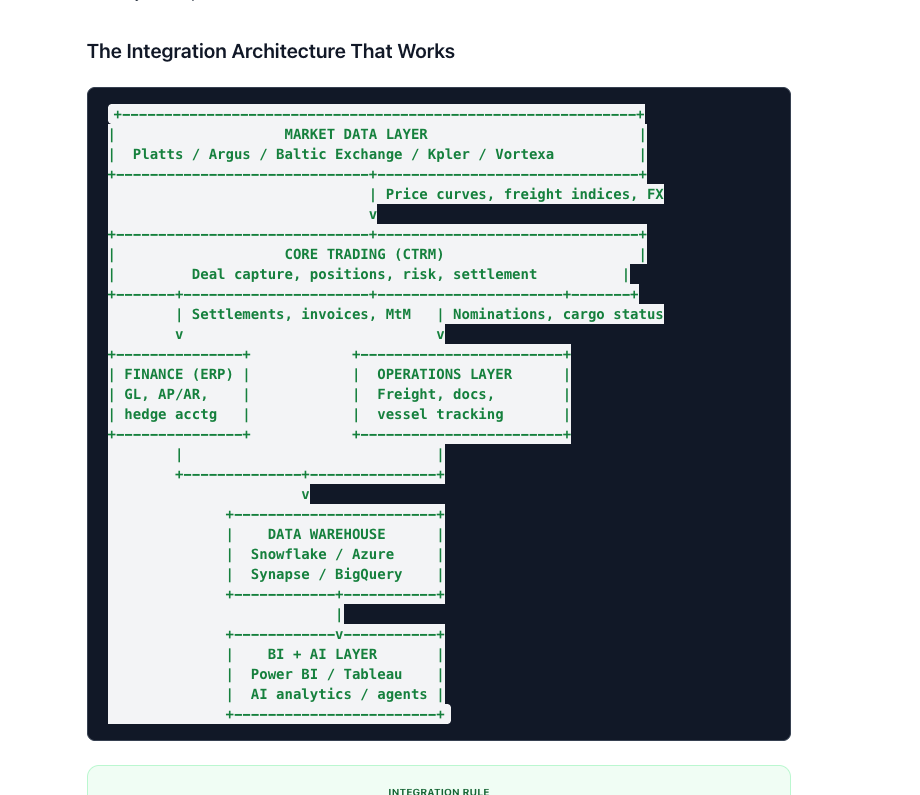
Reference architecture: market data → core systems → warehouse → BI/AI
Level 1 is not “buy an AI product.” It is reliable feeds from market data and CTRM into finance and operations, landing in a warehouse before any model sees them. If this diagram does not describe your firm today, fix the arrows before you fund LLM pilots.
LEVEL 1 - Data Foundation
  [ ] CTRM data is accurate and complete
  [ ] CTRM-to-ERP integration is automated (no manual re-keying)
  [ ] Freight procurement generates structured data (not email)
  [ ] Central data warehouse exists with feeds from core systems
  → If not here yet: fix this before any AI investment

LEVEL 2 - Document Intelligence
  [ ] Trade confirmations processed automatically
  [ ] Invoice reconciliation automated
  [ ] Discrepancy detection running in production
  → Ready for: contract analysis LLMs, basic agentic monitoring

LEVEL 3 - Operational Intelligence
  [ ] Demurrage analytics running on structured data
  [ ] Carrier performance data captured and analyzed
  [ ] Market intelligence corpus built and queryable
  → Ready for: advanced agentic AI, predictive models

LEVEL 4 - Predictive Intelligence
  [ ] Freight rate models trained on proprietary fixture history
  [ ] Counterparty risk monitoring automated
  [ ] Pre-trade analytics informing deal origination
→ Mastodon-tier capability. Sustainable competitive advantage.| Level | Focus | Typical mid-size desk (2026) |
|---|---|---|
| 1 | Data foundation | Most firms; start here |
| 2 | Document intelligence | Early production pilots |
| 3 | Operational intelligence | Requires clean ops + warehouse |
| 4 | Predictive intelligence | Proprietary data moat |
Most mid-size bulk commodity traders in 2026 are at Level 1 or early Level 2. That is not a criticism—it is an accurate baseline from which to plan. The firms that will dominate by 2027 are the ones that move systematically through this framework rather than trying to skip levels.
The 2027 Horizon: What Is Coming
Three AI developments will materially affect commodity trading operations by the end of 2027:
Generative AI in contract lifecycle management will move from pilot to production. AI systems that can draft contract amendments, identify non-standard clauses against a defined risk framework, and maintain full audit trails across contract versions will become standard infrastructure at mid-size and above. The administrative overhead of contract management—currently consuming significant senior operations time—will compress substantially.
Multi-agent systems for middle office automation will handle an increasing share of routine middle office functions: price quality checking, trade schedule monitoring, P&L discrepancy detection, and settlement instruction validation. The key development is not the individual agent capabilities but the coordination between agents—a vessel delay agent that automatically triggers a pricing exposure agent, which triggers a hedging review alert, which surfaces in a trader’s dashboard with full context. That chain of automated reasoning, currently requiring human coordination across multiple teams, will increasingly run autonomously.
Conversational interfaces for operational data will extend analytical capability to non-specialist users. A freight operator who wants to know the historical demurrage rate for a specific terminal in Q4 will ask the question in plain language and receive an answer drawn from your operational data corpus—without needing a data analyst to build a query. This democratization of operational intelligence is one of the highest-leverage AI applications available to mid-size firms that cannot afford large data science teams.
The Bottom Line
AI in commodity trading in 2026 is operational, not aspirational. The use cases that deliver real returns—document intelligence, contract risk flagging, agentic operations monitoring, market intelligence synthesis, counterparty risk monitoring, and freight rate intelligence—are production-ready today for firms that have built the right data foundation.
The competitive dynamic is straightforward: firms that build structured data infrastructure now will have proprietary AI capabilities in 2027 that firms still running on email and spreadsheets cannot replicate regardless of budget. The data moat compounds over time. Every structured fixture, every processed document, every monitored cargo adds to a dataset that becomes increasingly valuable as AI models train on it.
The sequence has not changed: clean data first, document automation second, operational intelligence third, predictive models fourth. What has changed is the urgency. The window for mid-size traders to build this foundation before the capability gap becomes insurmountable is measured in months, not years.
Bench Energy’s FreightTender platform is the fastest path to Level 1 data readiness for bulk commodity and chemical traders—replacing email-based freight procurement with structured, auditable digital tendering that generates the clean operational data every AI capability in this guide depends on.
Related: Bulk commodity trader tech stack · Maritime software guide (IMOS) · Dry bulk freight software
Reach Level 1 AI readiness on freight data
Every use case in the playbook needs structured fixtures and audit trails—FreightTender replaces email tendering so models have clean inputs.
Related Articles
- Freight Software for Shipping Companies (2026)
- Bulk Commodity Trader Tech Stack: The Complete 2026 Guide
- Your DMCC Audit Is Due June 30. Your Freight Procurement Documentation Will Fail It.
- The Hormuz Crisis Exposed a Fatal Flaw in How Dubai Commodity Traders Manage Freight Procurement
- The Tariff Hangover Is Here. Email-Based Freight Procurement Made It Worse.