Dry Bulk Freight Procurement Software for Commodity Traders
Key Takeaways
- Why general freight procurement software fails for dry bulk
- What dry bulk freight procurement software actually needs to do
- The email alternative and why it fails at scale
- What to look for in dry bulk freight procurement software
- Related articles
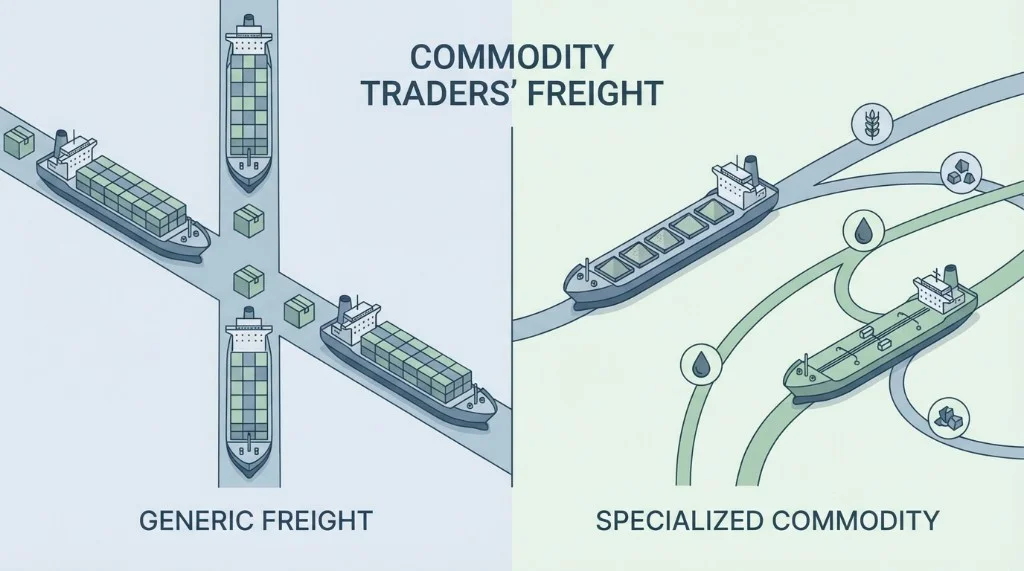
Search “freight procurement software” and you get Trimble, Alpega, GoComet, Transporeon. Every result is built for trucking companies, freight forwarders, and manufacturers managing container shipments on fixed lanes.
None of them are built for a commodity trading desk running 80 Panamax fixtures per year between Richards Bay, Kalimantan, and Qingdao.
The requirements are different. The problems are different. And the software that solves them is different.
Why general freight procurement software fails for dry bulk
General freight procurement platforms solve the right problem for the wrong market. They are built around carrier networks, rate management for contracted lanes, and TMS integration — the operational reality of a logistics department at a manufacturing company.
A dry bulk commodity trading desk does not have contracted lanes. It has a spot market, a charter party, a broker panel, and a laycan window that closes in 72 hours. The procurement problem is not “which carrier has the best rate on the Chicago–Atlanta lane this quarter.” It is “which of my 15 brokers will give me the best Panamax rate for a Richards Bay–Qingdao fixture loading in 8 days, and can I prove to my compliance team that the process was competitive.”
The table below shows why general freight software misses on every dimension that matters for dry bulk:
| Requirement | General freight software | Dry bulk requirement |
|---|---|---|
| Vessel type | Truck, container, air | Capesize, Panamax, Supramax |
| Route structure | Fixed lanes, annual contracts | Spot market, voyage charter |
| Broker model | Carrier network, pre-qualified | Shipbroker panel, relationship-based |
| Bid isolation | Not a feature | Critical — broker collusion risk |
| Charter party terms | Not applicable | Laytime, NOR, demurrage rate required |
| Compliance framework | General procurement | DMCC, MAS, FINMA specific |
| Audit trail | Basic approval workflow | Immutable bid-level log for regulator |
What dry bulk freight procurement software actually needs to do
Sealed-bid isolation
In a dry bulk broker market where 15–20 brokers cover any given major route, implicit coordination between brokers is the default outcome of email tendering. Each broker receives the same tender, gathers market intelligence through informal channels, and calibrates their offer against what they think others are bidding. The result is a coordinated rate floor — not a competitive market.
Dry bulk freight procurement software must structurally prevent this. Each broker invitation must be isolated: no broker can see who else was invited, what others submitted, or any information about competing offers at any point in the process. This is not a feature most general procurement platforms offer because trucking carriers do not have the same coordination dynamic.
Charter party field capture
A freight offer from a shipbroker is not a rate quote. It is the beginning of a charter party negotiation. The relevant fields are: freight rate per metric ton, vessel name and DWT, laycan confirmation, ETA at load port, demurrage rate per day, dispatch terms, NOR clause, and technical compliance with cargo specifications (sulfur content, moisture limits, vessel age restrictions).
Software that captures only a rate misses the 40% of fixture value that lives in these other terms. A vessel at $18/mt with a 6-day demurrage clock at $35,000/day is worse than a vessel at $19/mt with SHEX UU and a 5-day laytime — but only if the comparison is structured correctly.
BDI-linked reserve pricing
Before opening any tender, a freight director needs a defensible reserve price — the maximum rate above which the tender should be rejected and re-run. For dry bulk, this means integration with Baltic Exchange route assessments: C5 for Capesize West Australia–China, P3A for Panamax transpacific, S4A for Supramax. Software that does not connect reserve pricing to live market indices leaves traders negotiating blind.
Compliance audit trail for DMCC, MAS, and FINMA
Commodity trading desks in Dubai, Singapore, and Geneva face procurement documentation requirements that go beyond what general procurement software provides. DMCC's 2024 procurement guidance and MAS AML notices both require evidence of genuine competitive bidding — a timestamped, immutable record of invitations, offers, and award rationale that cannot be reconstructed after the fact.
The email alternative and why it fails at scale
Most commodity trading desks still run freight procurement via email. For a desk running 10–15 tenders per year, email works adequately. At 50+ tenders per year, the operational and financial costs become measurable:
The average Panamax tender on the Indonesia–India route involves 8–10 broker contacts, 15–25 emails, manual rate consolidation into a spreadsheet, and a 3–5 day cycle from tender opening to fixture. At 80 tenders per year, that is 1,200–2,000 emails, 80 spreadsheets, and 240–400 days of aggregate procurement time — before accounting for demurrage incidents caused by slow cycles.
The rate impact compounds the operational cost. Email tendering with 5–8 brokers in a connected market produces a coordination premium of 12–18% above what sealed competitive bidding achieves. For a desk with $8M annual freight spend, that premium is $960,000–$1.44M annually — money that transfers from trading margin to brokers, enabled entirely by the procurement process.
What to look for in dry bulk freight procurement software
Five questions to ask any vendor:
Does it enforce bid isolation? Not “does it support closed bidding” but does the platform make it technically impossible for brokers to see each other's offers at any point. This is the critical feature. Everything else is secondary.
Does it capture charter party fields, not just rates? The tender should require vessel name, laycan, NOR clause, demurrage rate, and technical compliance — not just a freight rate. Comparison should be on total cost, not headline rate.
What does the audit trail look like? Ask for an example export of the compliance file. It should show timestamped invitations, offer submissions with exact timestamps, and award rationale — in a format that can be presented to a DMCC or MAS auditor without modification.
Does it handle multiple commodity types? A desk trading coal, iron ore, and grain needs a platform that supports different cargo specifications for each commodity without requiring separate systems.
What is the broker onboarding process? The platform is only useful if your brokers use it. Ask how long broker onboarding typically takes and whether brokers need to create accounts or can submit via invitation link.
Related articles
- Capesize vs Panamax Freight Procurement: Different Vessels, Different Strategies
- Freight Cost as a Percentage of Trading Margin
- What Commodity Trade Finance Banks Now Require From Freight Procurement — And Why
- Why Commodity Traders Are Replacing Email Freight Tendering
- Demurrage in Dry Bulk Shipping: Why 70% Is Preventable
- Why Commodity Traders Need Specialized Freight Platforms
- Freight procurement software (landing)
FreightTender is built specifically for commodity and chemical trading desks running dry bulk freight tenders. Request a 15-minute demo →
Dry bulk procurement — not trucking TMS
Sealed bids, charter party fields, BDI-linked reserves, DMCC/MAS/FINMA logs. See FreightTender in 15 minutes.
Build your trading vocabulary
Commodity & Freight Trader's Lexicon
200+ Anki flashcards covering coal, metals, and oil trading — charter party clauses, laytime mechanics, FOB/CIF structures, price indices, and market terminology used by professional traders.
Related Articles
- Your DMCC Audit Is Due June 30. Your Freight Procurement Documentation Will Fail It.
- The Hormuz Crisis Exposed a Fatal Flaw in How Dubai Commodity Traders Manage Freight Procurement
- The Tariff Hangover Is Here. Email-Based Freight Procurement Made It Worse.
- What Commodity Trade Finance Banks Now Require From Freight Procurement — And Why
- Freight Cost as a Percentage of Trading Margin: The Calculation That Changes Procurement Decisions