The Hormuz Crisis Exposed a Fatal Flaw in How Dubai Commodity Traders Manage Freight Procurement
Key Takeaways
- 48h laycan risk vs 3–5d email = forced partial quotes + $50k+/d demurrage tail.
- 150+ ships near Hormuz → broker overload → 2/5 email responses in 72h.
- Closed-bid multi-scenario tenders → 8–18h full tables vs 3–5d email.
- War-risk +100–250% on routes; auditors will ask why each award was competitive.
- March 2026 FY2026 bookings → next DMCC cycle; WhatsApp is a weak file.
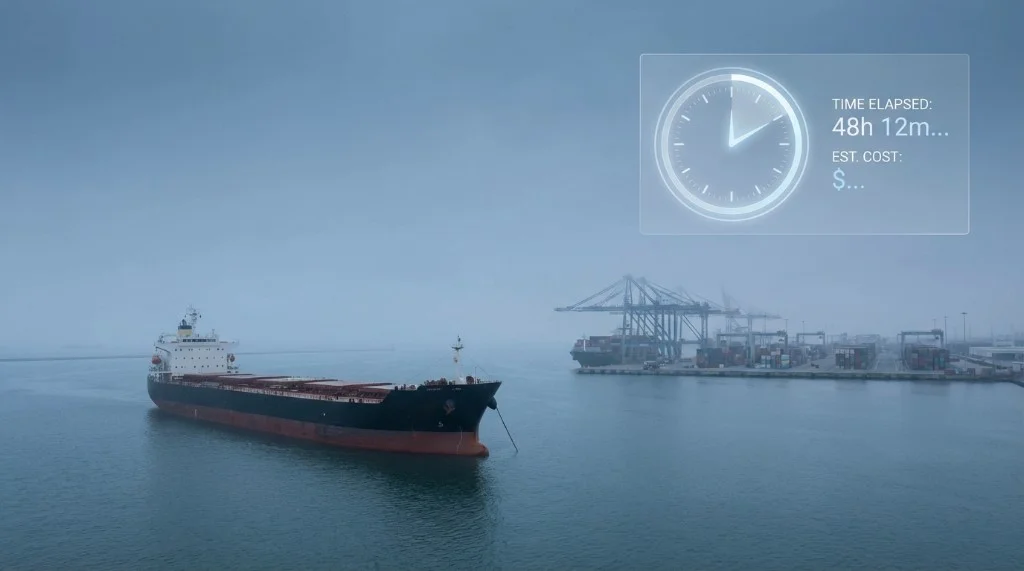
For whom: DMCC-registered crude, products, LNG, metals, and bulk desks fixing 5–20+ spot stems per week under chokepoint risk.
Bottom line: 48-hour decision windows collided with 3–5 day email cycles; $50,000+/day demurrage and +100–250% war-risk freight were live; structured sealed bids delivered 8–18 hour comparison tables and exportable audit files email could not produce.
On February 28, 2026, maritime traffic in the Persian Gulf froze.
Within 72 hours of the joint US-Israeli strikes on Iran, every major container carrier — Maersk, MSC, Hapag-Lloyd, CMA CGM, COSCO — had suspended transits through the Strait of Hormuz. MSC declared "End of Voyage" for all Arabian Gulf cargo. Jebel Ali was struck by an explosion on March 1. Brent crude surpassed $100/bbl on March 8 for the first time in four years, peaking near $126/bbl.
For Dubai-based traders, this was a live test of whether procurement could run at crisis clock speed — not broker charm.
What decisions did Dubai desks have to make in the first 48 hours of March 2026?
- Cape reroute: add 10–14 days steaming vs Hormuz passage — which cargoes could absorb the delay?
- Fallback ports: Salalah, Sohar, Khor Fakkan — which stems needed emergency discharge + feeder?
- Laycan / demurrage: which windows were <72 hours from breach at $50,000+ per day?
- Capacity: with ~150 ships stacked near the strait, which brokers could still name tonnage?
- Pricing: war-risk uplifts pushed indications 100–250% above pre-crisis baselines on some route classes — how to prove awards were still competitive?
Each line required comparable broker inputs within 48 hours. Email delivered partial, late, and non-normalized answers; sealed-bid stacks returned full matrices in 8–18 hours.
What does email tendering look like when Hormuz closes — response counts and time?
Typical pattern we observed across desks still on email:
- 5 brokers invited by urgent email within hour zero
- 2 preliminary indications back in <6 hours
- 1 formal quote next business day
- 2 no-shows — buried under 50+ parallel client fires
- 3 surviving quotes with different demurrage, war-risk, and rotation assumptions — not line-comparable without 4–8 hours of manual normalization
That is not an edge-case failure — it is the median email outcome under broker overload. Meanwhile the laycan clock loses 24 hours per day whether or not the inbox is clean.
How does that compare to normal email cycle length?
Peacetime email tendering already runs 3–5 days invite-to-award. Hormuz compressed the decision half-life to <48 hours for at-risk stems — a 3×–5× timing mismatch.
What did structured closed-bid procurement deliver during the same window?
Desks on closed-bid rails issued one tender object with three routing scenarios — e.g. A: Cape with named vessel class, B: Salalah + feeder, C: hold pending reopen — and forced brokers to bid comparable columns per scenario.
Resulting behavior we track in crisis simulations and live events:
- Full bid grid (all invited brokers × all scenarios) in 8–18 hours
- Immutable timestamp on every invite and every submission
- Award rationale captured at click, not reconstructed from WhatsApp
- Rate level: sealed bids remove the “only game in town” premium when brokers cannot see each other's levels — in stress markets that gap often measures high single digits to teens of percent vs sequential email reveals
Why will March 2026 fixtures create DMCC documentation risk in FY 2026 / FY 2027?
Emergency awards at 100–250% of pre-crisis freight will draw auditor questions — correctly. The FY 2025 DMCC filing deadline remains June 30, 2026, but March 2026 decisions sit in FY 2026 books and appear in the next cycle.
Files that are only WhatsApp screenshots + email forwards fail the same test as peacetime email: no symmetric invite proof, no bid isolation, no contemporaneous award memo. Structured exports close that gap in <2 hours per tender.
What should Dubai commodity traders assume about the next chokepoint event?
Assume <14 days from headline to operational impact. Assume broker response rates drop as global desks spam the same 15–25 dominant Gulf brokers. Assume demurrage stays $50,000+/day on large crude / LNG stems.
The only infrastructure question that matters: can you run a complete competitive process in <48 hours with an exportable file? Email's answer is no at scale; closed-bid's answer is yes on the metrics above.
FreightTender: sealed bids, routing scenarios, 8–18h cycles, DMCC-style exports — Dubai hub → · Request a demo →
Frequently asked questions
How fast did Brent crude move in March 2026?
Brent crossed $100/bbl on March 8 and peaked near $126/bbl during the disruption window.
How many ships were delayed near Hormuz?
Industry tallies at the time cited on the order of 150 vessels backed up outside the strait — squeezing broker capacity and response times.
What demurrage rate should desks model for tight laycans?
Large-tank and LNG contexts still routinely use $50,000+ per day as the planning demurrage line when laycan breach is imminent.
How long did email-based crisis tenders take vs closed-bid?
Email: often 2–3 partial quotes in 24–48 hours with manual reconciliation. Closed-bid: full comparison tables in 8–18 hours across multiple routing scenarios.
How large were war-risk freight uplifts?
Desk-collected indications during the peak window ranged about +100% to +250% vs pre-crisis baselines on affected route classes — exact print depended on vessel class and rotation.
When do March 2026 awards hit DMCC audit scope?
They fall in FY 2026 financials — reviewed in the following audit cycle after the June 30, 2026 FY 2025 wave.
Related articles
Crisis-speed freight procurement
Structured scenarios, sealed bids, full audit trail — built for Dubai energy and commodity desks. Request a demo.
Build your trading vocabulary
Commodity & Freight Trader's Lexicon
200+ Anki flashcards covering coal, metals, and oil trading — charter party clauses, laytime mechanics, FOB/CIF structures, price indices, and market terminology used by professional traders.
Related Articles
- Your DMCC Audit Is Due June 30. Your Freight Procurement Documentation Will Fail It.
- The Tariff Hangover Is Here. Email-Based Freight Procurement Made It Worse.
- What Commodity Trade Finance Banks Now Require From Freight Procurement — And Why
- Freight Cost as a Percentage of Trading Margin: The Calculation That Changes Procurement Decisions
- Capesize vs Panamax Freight Procurement: Different Vessels, Different Strategies