6 Hidden Forces Driving Coal Prices in 2026 — LNG, Hormuz, Ports & Finance
Key Takeaways
- Newcastle FOB ~$137.90/t vs $108.40/t at publication (~27%); managed thermal decline on hold through at least Q2 2026.
- Sixth force: LNG displacement — Qatar/UAE FM, >$20/mmbtu gas, coal back in Asian and European stacks.
- Force 3 revised: Panama + Suez + Hormuz simultaneous — fleet and routing stress unlike single-canal episodes.
- Freight: bunkers +30% WoW, war risk $1.50–3/t; example CFR India ~$170–175/t all-in vs January models.
- FFA + bunker monitoring are mandatory; eBL case strengthens as voyage times become unpredictable.
Originally published January 15, 2026 — Updated April 2026
Key takeaways (updated): Newcastle FOB 6000NAR $137.90/t (vs $108.40/t at publication); a sixth force — Hormuz blockade / LNG displacement; managed-decline thesis for thermal on hold through at least Q2 2026; freight volatility intensified (bunkers, war risk); original five forces still real — chokepoints now have a third dimension.
In the energy-transition narrative, coal is often treated as a stranded asset in terminal decline. The data is more volatile. At first publication, Newcastle near $108.40/t already defied a simple sunset story. After February 28 (Hormuz closure, LNG FM, >$20/mmbtu gas), benchmarks pushed into the high $130s/t, with tight physical windows printing above $165/t in early April. One driver wasn't in this framework three months ago.
This update adds a sixth hidden force and revises the first five for post-Hormuz reality. For the full trade-flow and playbook context, see our coal inflection longread.
Force 1: The "shadow price" of freight — more volatile than ever
Moving coal matters as much as mining it. The BDI / Capesize lens is still correct — inelastic tonnage, demand spikes, a structural freight tax. What changed is magnitude: Singapore bunkers up nearly 30% week-on-week after Hormuz; war risk on Middle East routing; spot coal routes jumping.
April 2026 illustration: Newcastle FOB $137.90/t; elevated Capesize Australia–India $28–32/t (vs ~$18–22/t in January); war risk ~$1.50–3.00/t; CFR India ~$170–175/t. Commodity up ~27%; freight stack adds another large wedge — unhedged buyers can be 45%+ above January procurement models.
FFA hedging is not optional. Monitor bunkers and war-risk premia as separate variables from the BDI alone.
Force 2: The $6.5B digital lag — Hormuz makes eBL more urgent
Paper Bills of Lading still arrive after ships; demurrage $25k–50k/day remains routine on paper workflows; McKinsey-scale inefficiency is still on the table. Hormuz adds stress: reroutes stretch voyages — document timing vs arrival breaks more often when baseline transit times are wrong.
Legal rails (UK ETDA, Singapore ETA) exist; coal eBL adoption is still <10%. Early movers' margin edge vs January likely widened because disruption tax on paper rose.
Force 3: Geopolitical chokepoints — three at once
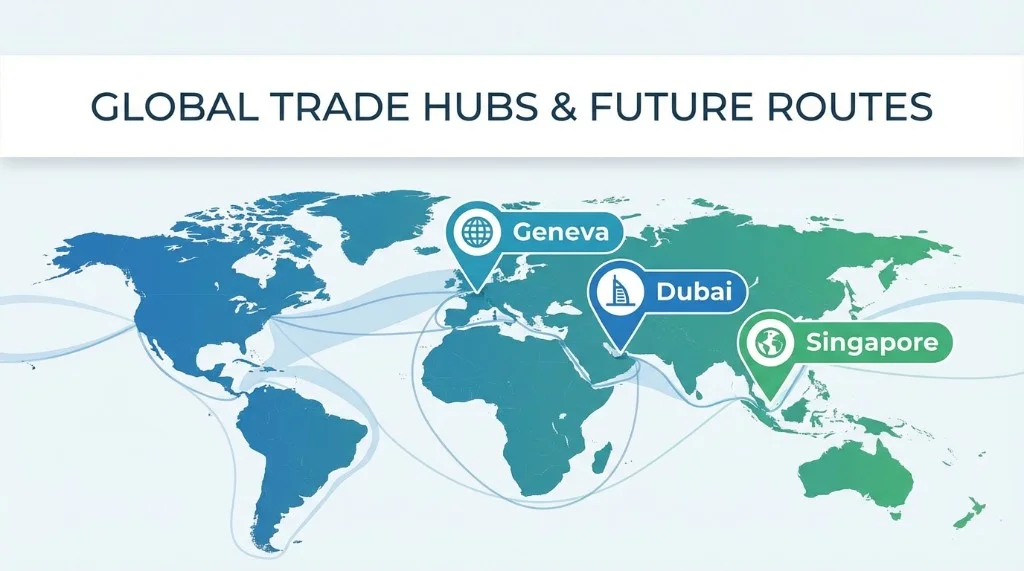
January covered Panama (drought capacity cuts) and Suez / Red Sea (Houthi risk, Cape reroutes, +~10 days, +3,000–3,500 nm). February 28 added Hormuz — ~20% of oil and ~19% of LNG. Unlike Panama/Suez (routing efficiency), Hormuz removed energy molecules, not just miles.
April 2026: Panama restricted; Suez dangerous; Hormuz closed after U.S./Israeli strikes — fleet simultaneously stretched by distance and pulled into emergency energy logistics. South Africa–Asia already Cape-routing; Australia–Europe faces higher bunkers; Colombia–Asia competes for ships with LNG replacement flows. The "capacity tax" is now compound, not single-vector.
Force 4: The India–China pivot — Hormuz reverses the thermal leg
Structure unchanged: China self-sufficiency vs Indian met coal growth. Near-term thermal revised: China imports 245–255 Mt (vs pre-Hormuz ~235 Mt) — 80% domestic mandate still in force, but LNG >$20/mmbtu slows import decline. India: 5–10 Mt thermal pressure from Gulf petcoke displacement on top of domestic production gains. Met coal: India's 500 MTPA steel path and import growth to 95–105 Mt by 2030 unchanged; geology (ash/sulfur) unchanged.
Force 5: Structured finance — ESG crunch meets energy emergency
Bank exits, ~10.6% blended costs, margin consumed by finance — still the baseline. Hormuz adds temporary political pressure in some jurisdictions to prioritize kilowatt-hours over ESG scoring for emergency procurement; that does not reverse bank coal exits structurally. eBL-collateralized structures still widen the gap between sophisticated and paper-based desks — and Hormuz widened that gap.
Force 6 (new): The LNG displacement shock
QatarEnergy FM on Ras Laffan; Qatar/UAE dominate Northeast Asian LNG; spot gas >$20/mmbtu; coal is the marginal replacement. Korea: price caps, coal curtailments under review. Taiwan: mothballed coal possible. Bangladesh/Thailand ramp coal burn. Wood Mackenzie: NE Asian LNG demand growth stalls in 2026; coal utilization fills the gap. Europe: tight gas storage, Atlantic LNG bid by Asia; Kpler aggressive switch adds ~8 Mt YoY toward ~30 Mt seaborne coal.
SCIA-style research: disruptions >4 weeks cascade through shipping — we are past that. Managed thermal decline is interrupted; duration of Hormuz resolution is the key option value.
The updated framework
| Force | Jan 2026 | Apr 2026 |
|---|---|---|
| Freight (BDI) | $15–35/t shadow | $28–40/t + war risk; bunkers +30% |
| Digital lag (eBL) | ~$6.5B inefficiency | Same, worse with voyage noise |
| Chokepoints | Panama + Suez | Panama + Suez + Hormuz |
| India–China | Thermal down, met up | Thermal floor; met same |
| Structured finance | ~10.6% blended | Same; emergency nuance |
| LNG displacement | — | Dominant near-term thermal driver |
The screen price is still only the start — there are now six engines under it.
Conclusion
Complexity still creates edge for prepared traders — but intensity jumped. The sixth force is currently the loudest. The energy transition is not cancelled; it is interrupted. The structural endpoint for coal is unchanged; the path now runs through Hormuz, bunkers, and LNG displacement.
Related: BDI & FFA strategies (updated) · Hormuz coal outlook · Get a 10-minute RFQ leakage audit
Sources: Wood Mackenzie, Kpler, Supply Chain Intelligence Institute Austria (SCIA), EIA, Trading Economics, Newcastle FOB, BIMCO, McKinsey, Natural Gas Intelligence
Freight procurement on your desk
Read the guides above for context. If you run brokered dry bulk RFQs, a 10-minute audit maps comparison, timing, and award evidence on one recent cargo.
Get a 10-minute RFQ leakage audit · Resources · FreightTender
Turn freight and tender data into a defendable file
Six hidden forces mean more moving parts — FreightTender structures invites, bids, and awards for procurement and finance.
Build your trading vocabulary
Coal Trader's Lexicon
200+ Anki flashcards for coal desks — thermal vs coking, FOB benchmarks, laytime, port congestion, and freight terms.