Cut Freight 40–60% When Hormuz Stacks Volatility on Laycans
Key Takeaways
- Slow procurement cycles that trigger demurrage charges
- Rate premiums from brokers exploiting information asymmetry
- Manual errors that delay shipments or duplicate bookings
- Compliance gaps that create regulatory risk
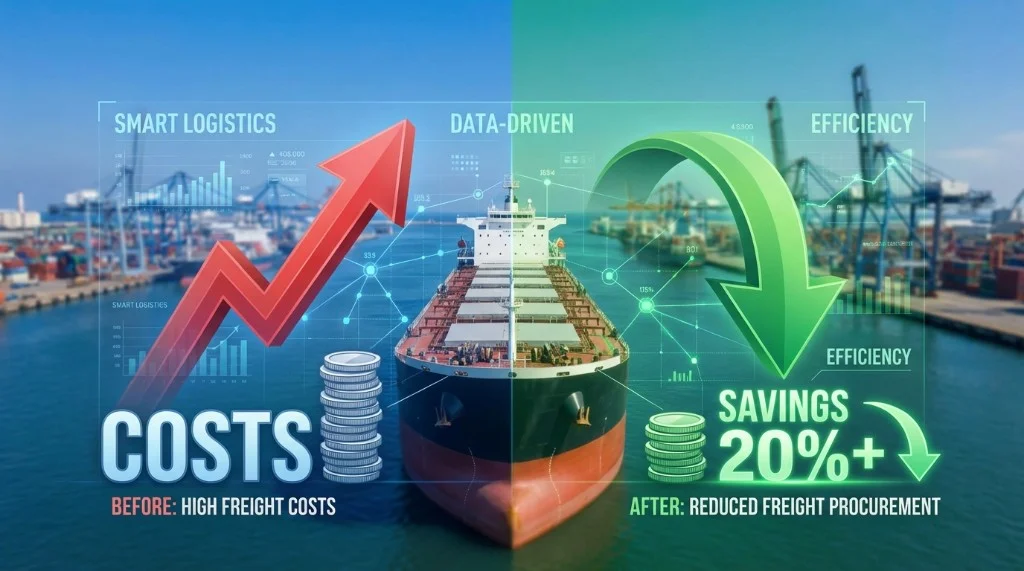
Freight procurement is one of the largest controllable costs in commodity trading. For a mid-sized coal or metals trader moving 50-100 shipments per month, freight costs can represent 15-25% of total deal margins.
Where savings come from
Illustrative: average rate premium above genuine market rate (%).
Yet most commodity traders still procure freight the same way they did in 2005: email requests, manual bid collection, spreadsheet tracking, and verbal confirmations.
Typical leakage on email-heavy desks:
- Slow procurement cycles that trigger demurrage charges
- Rate premiums from brokers exploiting information asymmetry
- Manual errors that delay shipments or duplicate bookings
- Compliance gaps that create regulatory risk
Desks that move to sealed bids and structured comparison often see faster awards, wider spreads, and less demurrage from timing — measure your own baseline on 20 fixtures.
April 2026 context: The late-February Hormuz closure and subsequent bunker and war-risk shocks did not change the playbook — they raised the cost of not running it. When every hour of email delay can land on a tighter laycan, sealed bids in 8–18 hours are not a nice-to-have.
This guide shows you exactly how.
Strategy 1: Eliminate Demurrage Through Speed (Potential Savings: 15-25%)
The problem
After laytime is exceeded, demurrage stacks quickly — typical Panamax $25K–$40K/day; a few days off the plan is six figures. (Mechanics & disputes: demurrage guide.) On Capesize (~150,000 t), multiply the daily exposure and savings math accordingly.
Most demurrage happens because freight procurement is slow. Here's the typical timeline:
- Day 1: Trader sends email to 5-10 brokers asking for freight quotes
- Day 2: Brokers respond with rates (some don't respond at all)
- Day 2-3: Trader compares quotes, negotiates, makes decision
- Day 3-4: Broker confirms with shipowner, gets approval
- Day 4-5: Freight is booked, vessel is nominated
By the time freight is booked, the vessel has already incurred 2-3 days of demurrage.
The solution: closed-bid tendering
Closed-bid tendering compresses this timeline from 3-5 days to 8-18 hours:
- Hour 0: Trader opens freight tender with specific parameters (origin, destination, commodity, dates)
- Hour 2-6: Brokers submit sealed bids (they can't see each other's offers)
- Hour 8: Tender closes, best rate is automatically selected
- Hour 12-18: Freight is booked and vessel is nominated
Why it works
Closed-bid tendering removes two sources of delay:
- informal bid signalling — When brokers see each other's quotes (open bidding), they collude to keep rates high. Closed bids prevent this, forcing competitive pricing.
- Manual negotiation — No back-and-forth haggling. Brokers know the rules upfront and submit their best rate immediately.
Illustrative numbers (same desk as the case study below)
A thermal coal desk using closed-bid tendering reported:
- Procurement cycle: Reduced from 4.2 days to 14 hours
- Demurrage charges: Dropped from $180,000/month to $8,000/month (aligned with the “after” row in the case study table)
- Annual demurrage savings: approximately $2.06 million
Strategy 2: Reduce Broker Rate Premiums (Potential Savings: 8-15%)
The problem
Brokers exploit information asymmetry. When you email 5 brokers asking for quotes, they know: you're desperate, you don't have a backup plan, you don't know the market rate, and you'll accept whatever they quote. Result: They quote 3-5% above market rate. For a $500,000 freight contract, a 4% premium costs you $20,000 on a single shipment. Learn how to choose a reliable freight broker who won't inflate rates.
The solution: competitive pressure + market transparency
Tactic 1: Invite More Brokers — Instead of emailing 5 brokers, invite 15-20. More competition = lower rates. 5 brokers: average rate premium 4-5%. 10 brokers: 2-3%. 15+ brokers: 0.5-1%.
Tactic 2: Use Market Data — Know the market rate before you tender. Use Baltic Dry Index (BDI) for dry bulk, Platts or Argus for energy/coal, freight rate indices from Clarkson or Braemar. When brokers know you understand the market, they can't quote inflated rates.
Illustrative numbers
A metals trader implemented competitive tendering with 18 brokers and market data: Previous average rate $45/ton → New $41.50/ton. Savings per shipment $7,000 (on 2,000-ton shipment). Annual shipments 60 → Annual savings $420,000.
Strategy 3: Eliminate Manual Errors (Potential Savings: 5-10%)
The problem
Email-based procurement creates errors: wrong destination, duplicate bookings, missed deadlines, compliance gaps. Each error costs $10,000-$50,000 to fix.
The solution: digital tendering platform
A digital platform eliminates errors by: (1) standardizing data entry, (2) providing an audit trail for every action, (3) automating workflows so freight is booked automatically when tender closes, (4) capturing all communications for compliance.
Illustrative numbers
A grain trader using email had 2-3 errors per month at $15,000 average cost → $360,000-$540,000 annually. After switching to digital tendering: 0.2 errors per month → Annual cost $36,000 → Annual savings $324,000-$504,000.
Strategy 4: Optimize Vessel Selection (Potential Savings: 5-8%)
Most traders accept the first vessel offered. When you tender, brokers should provide vessel name and type, ETA, condition, port fees, and insurance requirements so you compare total cost of ownership, not just freight rate. Example: Vessel A at $40/ton with 45-day ETA and $8,000 port fees vs Vessel B at $42/ton with 38-day ETA and $5,000 port fees — Vessel B can be $2/ton cheaper when you factor in faster delivery and lower port fees.
Strategy 5: Consolidate Shipments (Potential Savings: 3-7%)
Small shipments pay higher per-ton rates. 5,000 tons might be $45/ton, 20,000 tons $38/ton, 50,000 tons $32/ton. Do not coordinate with competing traders — that raises compliance and information-sharing issues. Instead, consolidate within your own book: combine cargoes or contracts you already control under one entity, or align internal desks (same legal entity) so back-to-back fixtures can share tonnage where laycans and charterparty terms allow. Example: five 5,000-ton shipments at $45/ton = $1,125,000 total; one 25,000-ton shipment at $38/ton = $950,000 — illustrative savings on the order of $175,000 on that bundle.
Real-World Case Study: Thermal Coal Desk (Dubai / Singapore)
Context: Mid-sized thermal coal desk; primary routes Richards Bay FOB → ARA and India; baseline Q1–Q2 2024, closed-bid programme Q3 2024–Q2 2026 (including high-volatility windows after the Feb 2026 Hormuz disruption).
Scale (same methodology as our broker-collusion guide): 120 freight fixtures per year, $50,000 average cost per fixture, $6.0 million annual freight spend (120 × $50,000).
Starting point: Email to 5–8 brokers, cycle time 4.2 days, demurrage $180,000/month, average rate $45/ton.
Changes: Closed-bid tendering (8–18 hour cycle), 18+ brokers, digital platform for audit trail, market data (BDI) for reserve prices, internal consolidation of own cargoes where laycans allowed (no competitor coordination).
Results after 6 months:
| Metric | Before | After | Improvement |
|---|---|---|---|
| Procurement cycle | 4.2 days | 14 hours | -87% |
| Demurrage/month | $180,000 | $8,000 | -95% |
| Broker rate premium | 4.2% | 0.8% | -81% |
| Average freight rate | $45/ton | $38.50/ton | -14% |
| Manual errors/month | 2.5 | 0.1 | -96% |
| Annual freight cost (all-in) | $6.0M | $4.62M | -23% (~$1.38M) |
Implementation Roadmap: 90-Day Plan
Follow our freight tendering best practices checklist for step-by-step guidance.
Week 1-2: Audit current process, identify top 20 brokers, gather 12 months of freight data, set baseline metrics.
Week 3-4: Run 5 closed-bid tenders manually; compare to historical tenders; measure cycle time, rates, participation.
Week 5-8: Select digital tendering platform, set up broker accounts, train team, run 10-15 tenders.
Week 9-12: Move all procurement to platform, consolidate where possible, integrate market data. Track spread, cycle time, and demurrage monthly — compare to your email baseline, not industry averages.
ROI Calculator: What You'll Save
Formula: Annual Freight Cost Reduction = (Current Annual Freight Spend) × (Cost Reduction %).
Example: $20M spend × 30% (demurrage 15% + rate 12% + errors 3%) = $6M annual savings.
- $10M/year freight → Save $3-6M/year
- $20M/year freight → Save $6-12M/year
- $50M/year freight → Save $15-30M/year
Why Digital Tendering Platforms Matter
Manual closed-bid (email) works, but digital platforms deliver: 8-18 hours vs 3-5 days; 20+ brokers vs 5-8; automatic audit trail; zero manual errors vs 2-3/month; historical analytics vs spreadsheets. The best platforms combine closed-bid logic, automated workflows, market data integration, compliance documentation, and API connections to your TMS/ERP.
Key Takeaways
- Demurrage is your biggest opportunity — Speed up procurement by 3-4 days, save $150,000+/month.
- Broker competition drives rates down — Invite 15+ brokers, save 3-4% on rates.
- Manual errors are expensive — Digital platforms eliminate them, save $300,000+/year.
- Vessel selection matters — Compare total cost, not just freight rate.
- Consolidation multiplies savings — When you combine your own tonnage (same entity), save 5–7% on per-ton rates.
- Speed = savings — Compress to 8-18 hours. Combined potential: tighten freight cost and cycle timecost reduction = $4-12M/year for mid-sized traders.
Next Steps
Ready to reduce your freight costs? (1) Audit your current process and baseline costs. (2) Calculate your demurrage. (3) Benchmark your rates — are you paying 3-5% above market? (4) Explore digital tendering — see how platforms compress procurement to 8-18 hours. The traders who move first capture the biggest savings.
Related: Complete Guide to Freight Procurement · Freight tendering best practices · How to choose a reliable freight broker · Email tendering problems · Dubai · Geneva · Singapore · FreightTender · ROI calculator
Start Your Freight Optimization →
Freight procurement on your desk
Read the guides above for context. If you run brokered dry bulk RFQs, a 10-minute audit maps comparison, timing, and award evidence on one recent cargo.
Get a 10-minute RFQ leakage audit · Resources · FreightTender
Reduce your freight costs 40-60%
Closed-bid tendering compresses cycles to 8–18 hours and cuts demurrage. Get an RFQ leakage audit or use the ROI calculator.
Build your trading vocabulary
Commodity & Freight Trader's Lexicon
200+ Anki flashcards per deck — charter party clauses, laytime, FOB/CIF, indices, and desk terminology. Instant download after checkout on Gumroad.
Related Articles
- The Hormuz Crisis Exposed a Fatal Flaw in How Dubai Commodity Traders Manage Freight Procurement
- The Complete Freight Procurement Guide (6 chapters)
- Bulk Commodity Trader Technology Stack (2026)
- Freight Tendering Best Practices: 15-Step Checklist to Cut Costs 25–40%
- How to Negotiate Freight Rates in a Volatile Market