Demurrage in Dry Bulk: Cut Costs 70% | Commodity Trading
Key Takeaways
- What dry bulk demurrage actually costs
- The four controllable causes — and one that is not
- How to dispute the 20–30% of demurrage invoices that contain errors
- Building a demurrage tracking system that actually works
- Related articles
Every article about reducing demurrage charges gives the same advice: plan ahead, communicate with carriers, monitor shipments. This advice is written for container shipping operations managing detention fees at port terminals.
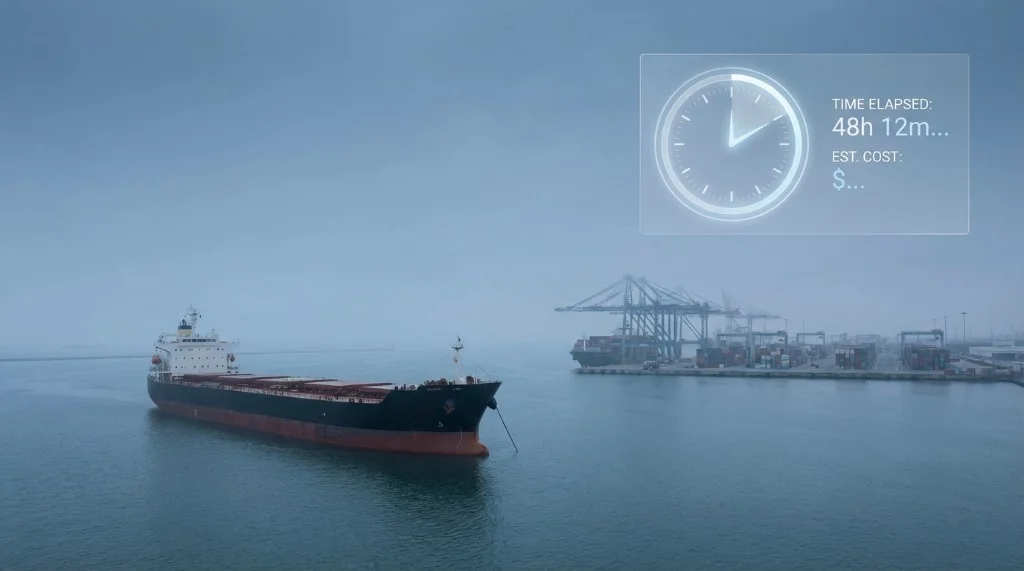
Dry bulk demurrage is a different problem with different causes and different solutions. It is not about containers sitting at terminals. It is about Capesize and Panamax vessels waiting at anchorage because the charterer was not ready — and the clock running at $35,000–$55,000 per day while they waited.
The distinction matters because the prevention strategies are different, and most of the generic demurrage advice does not apply.
What dry bulk demurrage actually costs
The numbers are different in magnitude from container demurrage. A Capesize vessel at Richards Bay waiting 4 days beyond laytime at $45,000/day = $180,000 on a single fixture. A Panamax at Paradip waiting 3 days at $30,000/day = $90,000.
For a commodity trading desk running 80 fixtures per year with an average demurrage incident rate of 8% of fixtures — industry average for email-based procurement — that is 6–7 demurrage incidents per year at $60,000–$150,000 average cost. Annual demurrage exposure: $360,000–$1.05M before disputes.
The 70% preventability figure is not aspirational. It is the outcome difference between desks that have systematically addressed the four controllable causes and those that have not.
The four controllable causes — and one that is not
Cause 1: Freight procurement too slow (15% of incidents — highest ROI fix)
The most preventable category. A trading desk that books freight 48 hours before the laycan opens is structurally exposed to demurrage at the load port. The vessel arrives, tenders NOR, and the laytime clock starts — regardless of whether cargo is ready.
The fix is mechanical: compress the freight procurement cycle from 3–5 days to 8–18 hours using sealed-bid tendering, and establish a policy of booking freight minimum 5 working days before the laycan opens. This single change eliminates the entire procurement-related demurrage category.
The reason most desks have not done this is that compressing the cycle requires a different procurement process. Email tendering with 5–8 brokers takes 3–5 days structurally — brokers need time to find vessels, coordinate with shipowners, and submit. Sealed-bid tendering with a deadline of 8–12 hours forces the cycle to compress because all brokers submit simultaneously to a fixed deadline.
Cause 2: Documentation delays (20% of incidents)
A letter of credit not in place, a customs filing not completed, a bill of lading template not agreed before vessel arrival. Each of these can stop loading operations for 24–48 hours — $30,000–$110,000 on a single fixture.
The fix is a documentation checklist owned by one person per fixture, with a 48-hour pre-arrival deadline for every item. Not a spreadsheet that gets checked after the problem arises — a timestamped pre-arrival checklist that triggers when the vessel is 4 days out.
The specific items that cause the most incidents: LC not confirmed before NOR (most common), phytosanitary certificate for grain not issued (seasonal), bill of lading template not agreed with the buyer (common on new counterparty relationships), and cargo inspection appointment not booked before vessel arrival (overlooked most often in busy periods).
Cause 3: Port congestion — the partially controllable cause (35% of incidents)
Port congestion is not directly controllable but is predictable and partially avoidable through port selection and timing.
Newcastle coal export terminal averages 3–5 day anchorage queues in Q4, driven by Australian thermal coal export peaks. Paradip averages 4–7 day berth waits during Indian power demand peaks (March–May, September–October). Qinhuangdao is highly seasonal, with 5–10 day queues during Chinese winter heating season (November–February).
Two levers: first, route optimization — at Paradip, a 3-day berth wait at $30,000/day = $90,000 in demurrage. Mundra handles the same cargo with 1–2 day waits. The rate difference is $1–2/mt. On a 75,000 mt cargo, $90,000 in demurrage savings versus $75,000–$150,000 in rate premium — the port selection decision is worth calculating explicitly rather than defaulting to the buyer's preferred port.
Second lever: laytime clause negotiation. NOR “on berthing” instead of “on arrival” at a port with 5-day average anchorage queue eliminates 5 × daily demurrage from your exposure on that fixture. This is a charter party negotiating point, not a procurement point — but it compounds across every fixture at congested ports.
Cause 4: Slow loading/discharge operations (25% of incidents)
Equipment breakdown at the terminal, rain stoppages at moisture-sensitive ports, labor disputes, tide restrictions. Some of this is genuinely uncontrollable. Some of it is charterer responsibility — cargo not ready at the berth, conveyor systems not prepared, shore equipment not booked.
The controllable portion: cargo readiness at berth. At every load port, confirm cargo is physically at the berth (not just at the terminal) before the vessel arrives. The 24-hour gap between “cargo is at the terminal” and “cargo is at the berth” is a common hidden cause of the first 24 hours of demurrage on coal and grain fixtures.
The uncontrollable cause (5%): Cargo quality issues
Failed inspection, moisture exceeding charter party limits, grade mismatch. Genuinely difficult to prevent beyond standard quality control. Not worth optimizing for until the four controllable categories are addressed.
How to dispute the 20–30% of demurrage invoices that contain errors
Systematic review of demurrage invoices against charter party terms recovers 15–25% of invoiced amounts on average. The errors are not random — they cluster in four categories:
NOR validity. If the vessel tendered NOR before receiving free pratique, the laytime clock should not start until free pratique. At anchorage-heavy ports, the gap between NOR and free pratique can be 12–18 hours — $17,500–$27,500 on a Capesize fixture at $35,000/day.
Equipment failure time. If vessel equipment failure interrupted loading or discharge, that time is typically excluded from laytime under most charter party forms. Shipowners' statements frequently include it. Your port agent's independent timesheet is the evidence.
Weather exclusions that extend to demurrage. If your charter party contains a weather working days clause that explicitly extends to the demurrage period (four specific words: “and such time shall not count as demurrage”), rain stoppages after laytime expires are excluded. Most statements do not apply this correctly.
Reversible laytime miscalculation. On voyage charters with reversible laytime provisions, time saved at load port offsets demurrage at discharge. Shipowners calculate each port separately unless the charterer raises the reversibility clause.
The process: receive the statement of facts within 30 days of final discharge, cross-reference against your port agent's independent timesheet line by line, issue a formal written counter-statement for every disputed period. The BIMCO 90-day limitation period for demurrage claims applies to your counter-claims too — miss it and the dispute is barred regardless of merit.
Building a demurrage tracking system that actually works
Most commodity trading desks track demurrage as a line item on the P&L, not as a process metric. The result is that demurrage accumulates without pattern recognition.
Three metrics to track per fixture, per quarter:
Procurement lead time to fixture. Days between tender opening and fixture confirmation. Target: 5+ days before laycan opens. Any fixture confirmed with less than 3 days before laycan is a demurrage risk flag.
Demurrage as percentage of freight spend. Industry benchmark: below 3% is excellent, 3–7% is average, above 7% is a systematic process problem. Calculate this quarterly, not annually — seasonal patterns reveal themselves in quarterly data.
Demurrage by cause. When demurrage is incurred, categorize it: procurement speed, documentation, port congestion, loading operations, cargo quality. After 6 months of data, the distribution tells you exactly where to invest prevention effort.
Related articles
- Capesize vs Panamax Freight Procurement (demurrage rates & lead times)
- Charter Party Red Flags Before Signing
- What Is Demurrage (and How Traders Avoid It)
- Demurrage Costs and Procurement Speed: The Hidden Link
- Freight Cost as a Percentage of Trading Margin
- Dry Bulk Freight Procurement Software
- Demurrage reduction (landing)
FreightTender compresses freight procurement to 6–12 hours, eliminating the procurement-speed category of demurrage entirely. See how it works →
Cut procurement-driven demurrage first
Compress tendering to hours, fix documentation and port selection. Model impact on your desk — book a demo.
Build your trading vocabulary
Commodity & Freight Trader's Lexicon
200+ Anki flashcards covering coal, metals, and oil trading — charter party clauses, laytime mechanics, FOB/CIF structures, price indices, and market terminology used by professional traders.
Related Articles
- Your DMCC Audit Is Due June 30. Your Freight Procurement Documentation Will Fail It.
- The Hormuz Crisis Exposed a Fatal Flaw in How Dubai Commodity Traders Manage Freight Procurement
- The Tariff Hangover Is Here. Email-Based Freight Procurement Made It Worse.
- What Commodity Trade Finance Banks Now Require From Freight Procurement — And Why
- Freight Cost as a Percentage of Trading Margin: The Calculation That Changes Procurement Decisions