Negotiate Freight in a Hormuz + Bunker Shock (8 Tactics)
Key Takeaways
- Understanding Freight Market Cycles
- 8 Negotiation Tactics for Lower Freight Rates
- Negotiation by Market Phase
- Key Takeaways
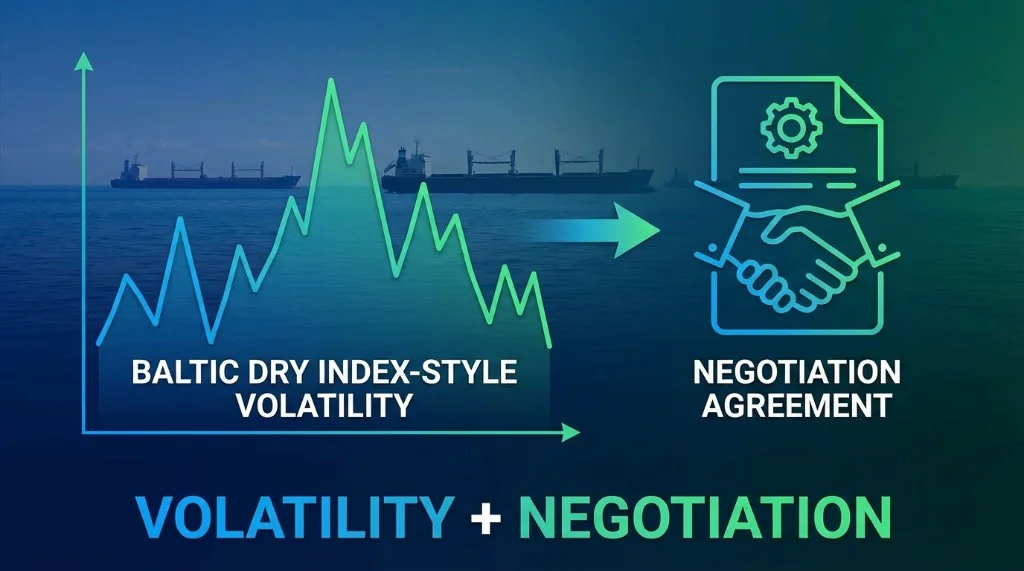
Freight curves can move 30–40% in a month on the same route. After the February 28, 2026 Hormuz closure, bunker costs and war-risk premia added another layer on top of Baltic hire — so the same route can reprices on fuel and risk even when headline indices move slowly. For commodity traders that creates risk (locking in panic levels) and optionality (pressing when lists are long). This guide is a tactical checklist — timing, competition, and total cost — not a primer on what BDI measures.
Understanding Freight Market Cycles
Phase 1: Trough — Route indices at lows, abundant tonnage, brokers willing to sharpen. Best: lock period/COA when credit checks clear. Phase 2: Recovery — Indices rising, lists tightening. Best: medium-term cover before peak. Phase 3: Peak — Indices high, vessels scarce. Best: draw on earlier cover, minimise spot. Phase 4: Decline — Indices off. Best: short fixtures, avoid new longs. Identify phase via Baltic route curves (balticexchange.com), 12m/3y context, orderbook, macro (e.g. steel / tonne-mile drivers).
8 Negotiation Tactics for Lower Freight Rates
Tactic 1: Time Your Tenders Strategically
Best: Monday–Tuesday, mid-month, after your route index has softened (e.g. 5%+ move in the relevant Capesize/Panamax assessment), Jan–Feb, August. Worst: end of month, pre-holidays, post-disruption panic, Chinese demand spikes. Illustrative: same cargo, same route — tender dated 15 March at $48/t vs 28 March at $43/t after a two-week slide in the applicable Baltic route curve (not noise — the index moved with open tonnage). That $5/t × 20,000 t = $100,000 on a Handymax/Supramax parcel. Scale: at Capesize volumes (~150,000 t), the same $5/t = $750,000.
Tactic 2: Use Published Curves as Your Anchor
Check the route-specific Baltic assessment (and cargo-specific adjustments), add commission and lump-sum conversions as needed, set a budget / walk-away ceiling — not a seller’s "reserve" (that term is a floor in auction language). When brokers quote above the curve, cite the published level. Desks that anchor awards to indices pay 2–4% less.
Tactic 3: Create Genuine Competition
Invite 15–20 brokers, closed-bid, 6–12 hour deadline. Open bidding, five brokers: $46/t; closed, 15 brokers: $41/t → $100,000 on 20,000 t; same spread on 150,000 t Capesize = $750,000. Market data also helps you choose reliable brokers who quote honest rates.
Tactic 4: Offer Volume Commitments
"We ship 8-10 Panamax cargoes/year on this route; if you offer 3-4% below spot we'll commit 6 cargoes annually." Get 3-5% discount and priority access when tight. Best for predictable, recurring routes.
Tactic 5: Negotiate in Market Troughs
When route indices sit at 12-month lows: sign 6–12 month COAs or period deals at current levels with a cap (e.g. freight won’t exceed index + X%). Example: lock time-charter equivalent at $15,500/day when the curve implies $15,000; three months later the market is $22,000 → meaningful savings versus spot — but trough counterparties are often the weakest owners. Before locking long tenor, run the same credit / performance screening you would on any major counterparty: financials, P&I club, arrest history, fleet age. A cheap long-term fixture with an owner that later goes bust is not a win. One long-term deal with a stressed counterparty can wipe out years of freight savings.
Tactic 6: Separate Freight from Ancillary Costs
Break down: freight, port fees, demurrage rate, despatch, insurance, fuel, canal fees. Negotiate each. $42/t all-in → $40.50/t = $30,000 on 20,000 t; on 150,000 t Capesize the same $1.50/t = $225,000.
Tactic 7: Use Alternative Routes as Leverage
If cargo can ship via multiple routes, use as leverage. "I can source from South Africa at $36/ton all-in. Match or beat for Colombian?" Only use alternatives you can execute.
Tactic 8: Build Relationships for Tight Markets
When vessels scarce, owners prioritize clients who pay on time, don't dispute legitimate demurrage, give volume, treat brokers professionally. In 2021 spike, strong-relationship traders secured $45,000/day when spot was $65,000/day → $600,000 saved on one cargo.
Negotiation by Market Phase
| Phase | Best Tactics | Avoid |
|---|---|---|
| Trough | Long-term contracts, volume deals | Spot-only |
| Recovery | Medium-term fixtures | Waiting for peak |
| Peak | Use existing contracts, minimize spot | New long-term |
| Decline | Maximize spot, short fixtures | Long-term contracts |
Key Takeaways
- Know your market phase—route indices tell you spot vs lock-in.
- Use published curves as anchor—never negotiate without a market level.
- Create genuine competition—15+ brokers, closed-bid.
- Time tenders—Monday vs Friday can mean $3-5/ton.
- Negotiate in troughs—long-term at lows saves millions when rates spike.
- Break down total cost—negotiate freight, port fees, demurrage separately.
- Build relationships—in tight markets worth more than any tactic.
Reducing demurrage is another major lever—see our complete demurrage guide. Master these 8 tactics and you'll consistently pay 10-20% below market average.
Related: Complete Guide to Freight Procurement · Reduce freight costs · Best practices · Demurrage guide · Compliance · FreightTender · Get a 10-minute RFQ leakage audit
See How FreightTender Automates Competitive Freight Negotiation →
Freight procurement on your desk
Read the guides above for context. If you run brokered dry bulk RFQs, a 10-minute audit maps comparison, timing, and award evidence on one recent cargo.
Get a 10-minute RFQ leakage audit · Resources · FreightTender
Run competitive tenders in any market
Closed-bid tendering with 15+ brokers and BDI-based reserve pricing. FreightTender automates the process.
Build your trading vocabulary
Commodity & Freight Trader's Lexicon
200+ Anki flashcards per deck — charter party clauses, laytime, FOB/CIF, indices, and desk terminology. Instant download after checkout on Gumroad.
Related Articles
- The Hormuz Crisis Exposed a Fatal Flaw in How Dubai Commodity Traders Manage Freight Procurement
- The Complete Freight Procurement Guide (6 chapters)
- Freight Tendering Best Practices: 15-Step Checklist to Cut Costs 25–40%
- Beyond the Index: Using the BDI as a Strategic Trading Tool
- The Bid Spread Test: Are Your Brokers Competing?