Freight Tendering Compliance: DMCC, FINMA, MAS Rules
Key Takeaways
- Documentation of the competitive process used to select carriers and brokers
- Evidence that procurement decisions were made at arm's length
- Audit trail showing who made procurement decisions and on what basis
- Records retention for a minimum of five years
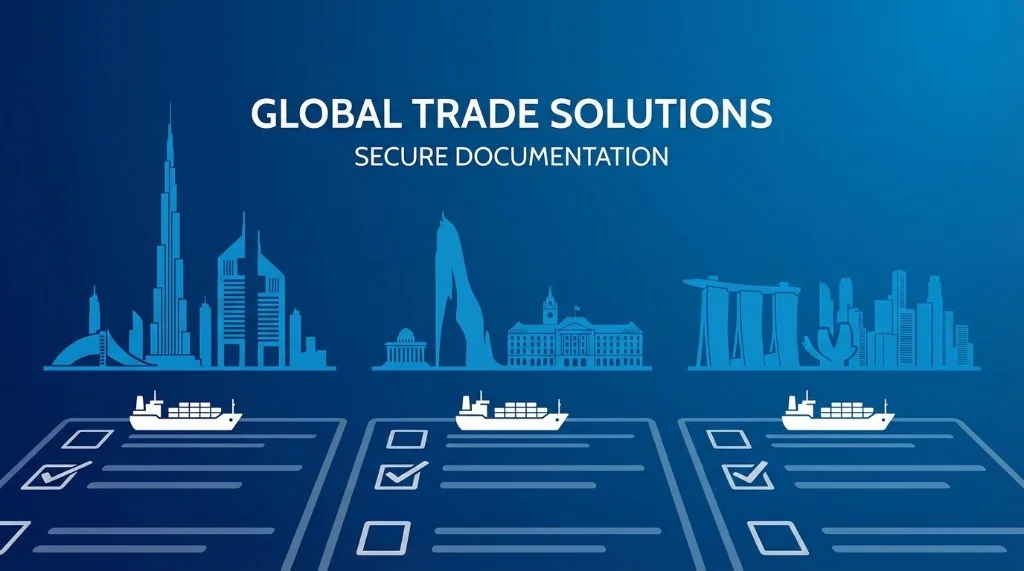
Commodity trading regulation is tightening globally. Dubai, Geneva, and Singapore — the three largest commodity trading hubs — have each introduced or strengthened regulatory frameworks that affect how trading companies document procurement decisions.
| Requirement | Email tendering | Platform |
|---|---|---|
| Invitation symmetry | Weak proof | Timestamped log |
| Bid isolation | Not provable | By design |
| Retention | Fragmented | Exportable archive |
Freight tendering is increasingly in scope. Regulators want to know: was this procurement decision made through a genuine competitive process? Can you document why this broker was selected at this rate?
Email tendering cannot answer these questions. Here's what each hub requires and how to comply.
Dubai: DMCC Compliance
The Dubai Multi Commodities Centre (DMCC) is the world's largest free zone for commodities trading, with over 4,000 registered companies. DMCC's regulatory framework has been strengthening steadily, with increasing requirements around procurement documentation and anti-corruption controls.
For freight procurement, DMCC compliance requires:
- Documentation of the competitive process used to select carriers and brokers
- Evidence that procurement decisions were made at arm's length
- Audit trail showing who made procurement decisions and on what basis
- Records retention for a minimum of five years
Email tendering fails on all four requirements. Email chains can be deleted, modified, or selectively shared. There is no mechanism for proving arm's length dealing. There is no structured audit trail.
Closed-bid tendering addresses each requirement: every invitation, submission, and award decision is timestamped, logged, and immutable. The audit trail is exportable for DMCC compliance records.
Geneva: FINMA and Swiss Regulatory Requirements
Geneva's commodity trading sector operates under FINMA oversight and Swiss financial regulations that have been tightening since the Gunvor, Vitol, and Glencore enforcement actions of the early 2020s.
Swiss regulators now expect commodity trading companies to demonstrate:
- Robust anti-corruption controls in procurement processes
- Documentation of competitive processes for material procurement decisions
- Clear separation between trading decisions and procurement decisions
- Audit trails that support internal and external audit requirements
Freight procurement is a material procurement decision for commodity traders. A trading company that cannot demonstrate a genuine competitive process for freight tendering is exposed to regulatory risk.
Closed-bid tendering provides the documentation framework Swiss regulators expect: structured competitive process, immutable audit trail, documented award rationale.
Singapore: MAS Requirements
The Monetary Authority of Singapore (MAS) has been strengthening oversight of commodity trading operations following several high-profile enforcement actions. MAS expects Singapore-based commodity trading companies to maintain:
- Robust internal controls around procurement decisions
- Documentation supporting the integrity of competitive processes
- Audit trails for material procurement decisions
- Evidence of arm's length dealing with brokers and counterparties
MAS has specifically flagged procurement processes as an area of focus in recent guidance to commodity trading companies. Email tendering — with no bid isolation, no audit trail, and no mechanism for preventing broker collusion — is increasingly difficult to defend under MAS scrutiny.
Closed-bid tendering provides the control framework MAS expects: bid isolation prevents collusion, standardized offer format ensures comparability, immutable audit trail documents the competitive process.
The compliance case for closed-bid tendering
The regulatory trend across all three hubs is consistent: commodity trading companies are expected to demonstrate that procurement decisions were made through genuine competitive processes, with documented rationale and audit trails.
Email tendering cannot meet this standard. Closed-bid tendering can.
FreightTender provides:
- Immutable audit log: every invitation, submission, and award decision timestamped and logged
- Bid isolation: closed-bid architecture prevents broker collusion
- Standardized offer format: ensures comparability and documents the basis for award decisions
- Exportable compliance records: audit log exportable for DMCC, FINMA, and MAS compliance
- Five-year record retention: meets minimum retention requirements across all three hubs
For commodity trading companies in Dubai, Geneva, and Singapore, closed-bid tendering is not just a procurement efficiency tool. It's a compliance requirement.
Common compliance failures in freight procurement
Across all three regulatory jurisdictions, the same compliance failures appear repeatedly when freight procurement is conducted through email or informal processes.
No audit trail
The most common failure is the absence of a structured, immutable audit trail. When an internal auditor or regulator asks to see the procurement record for a specific cargo, the freight manager must reconstruct the process from email threads, chat messages, and memory. Emails can be deleted — intentionally or through routine mailbox management. Chat records may not be retained. The resulting "audit trail" has gaps, inconsistencies, and no guarantee of completeness.
Regulators in all three hubs now expect procurement records to be systematic, not reconstructed. A process that relies on email is a process that cannot be audited with confidence.
Verbal agreements
Freight fixtures frequently involve verbal agreements — phone calls between traders and brokers where rates, vessel nominations, and laycan terms are agreed before any written confirmation is produced. In many cases, the written confirmation is a post-hoc email that formalises a decision already made verbally.
This is a compliance problem because there is no record of the competitive process — if one existed at all — that led to the verbal agreement. Regulators view verbal agreements in procurement as a red flag for corruption and preferential dealing. A closed-bid platform eliminates this risk by requiring all offers to be submitted in writing, in a structured format, before any award decision is made.
Retrospective offer changes
In email tendering, brokers sometimes revise their offers after submission — adjusting rates, changing vessel nominations, or modifying laycan terms. When offers are exchanged via email, there is no mechanism to prevent or even detect these revisions. The trader may not realise that the "final" offer is different from the original submission.
Closed-bid platforms enforce offer immutability. Once a broker submits an offer, it cannot be changed. Any revised offer is logged as a separate submission with its own timestamp, preserving the full history of the tendering process.
Missing documentation
Even when a competitive process is conducted, the documentation is often incomplete. Tender invitations may not list all brokers contacted. Offers from brokers who were not selected may not be retained. The rationale for the award decision may not be documented at all. Over time, as staff turnover occurs and memory fades, the procurement record becomes increasingly fragmentary.
Platform tendering generates complete documentation automatically. Every invitation, every offer, every comparison, and every award decision is logged with timestamps, user identities, and structured data. The documentation is complete by design, not by discipline.
Building a compliance-ready procurement process
Commodity trading companies that want to meet regulatory expectations across Dubai, Geneva, and Singapore should implement five specific controls in their freight procurement process.
1. Document every tender
Every freight tender — regardless of size or urgency — must produce a complete procurement record. This includes the tender invitation (with all brokers contacted), all offers received, the comparison basis, the award decision, and the rationale. "We were in a hurry" is not a valid reason for incomplete documentation. Regulators expect consistent processes regardless of operational pressure.
2. Use standardised offer formats
Offers must be submitted in a structured, standardised format that enables like-for-like comparison. When brokers submit offers in different formats — some as emails, some as attachments, some as phone quotes — the comparison is subjective and undocumented. A standardised offer format with fixed fields for rate, vessel, laycan, technical specifications, and terms ensures that every offer is comparable and the basis for the award decision is transparent.
3. Maintain immutable records
Procurement records must be immutable — they cannot be altered, deleted, or selectively shared after the fact. Email does not provide this guarantee. A purpose-built platform with write-once, read-many record architecture ensures that the procurement record as seen by auditors is identical to the procurement record as it existed at the time of the decision.
4. Implement role-based access control
Access to procurement data should be controlled by role. Traders who create tenders should not be able to modify audit logs. Brokers should see only their own invitations and offers. Compliance officers should have read-only access to all records. Management should be able to review procurement patterns and exceptions. Role-based access control (RBAC) prevents unauthorised modifications and ensures that the audit trail is trustworthy.
5. Automate retention
All three regulatory jurisdictions require minimum record retention periods — five years for DMCC, and comparable requirements under FINMA and MAS guidance. Manual retention — saving emails to folders, archiving spreadsheets — is unreliable. Records get lost, deleted, or become inaccessible as systems change. Automated retention within a platform ensures that all procurement records are preserved for the required period without manual intervention.
Penalties and enforcement trends
The regulatory environment for commodity trading procurement is not static. All three hubs are moving toward stricter oversight, with increasing penalties for non-compliance.
DMCC enforcement
DMCC has progressively strengthened its enforcement capabilities. Penalties for non-compliance with procurement documentation requirements include fines of up to AED 500,000 (approximately $136,000) per violation, suspension of trading licences for repeated offences, and mandatory remediation programmes. DMCC's audit teams have increased the frequency and depth of compliance inspections, with procurement documentation now a standard line item in routine audits.
The trend is toward greater scrutiny, not less. DMCC has publicly stated its intention to align its regulatory framework with international best practices, which means commodity trading companies should expect procurement documentation requirements to become more stringent over time.
FINMA enforcement
FINMA's enforcement actions against commodity trading companies have made global headlines. The Gunvor settlement, Vitol's deferred prosecution agreement, and Glencore's guilty plea all involved procurement-related misconduct. While these cases centred on bribery and corruption, the underlying compliance failure was the same: inadequate controls and documentation around procurement decisions.
FINMA now applies enhanced due diligence expectations to commodity trading companies operating out of Geneva. Trading companies are expected to demonstrate that their procurement processes — including freight tendering — have robust controls, documented competitive processes, and audit trails that can withstand external scrutiny. The penalty for non-compliance ranges from formal warnings to licence revocation, with fines that can reach into the tens of millions of Swiss francs for serious breaches.
MAS enforcement
MAS has taken an increasingly firm stance on commodity trading oversight, driven by high-profile failures including the Hin Leong collapse and the ZenRock trading fraud. MAS penalties for inadequate internal controls include fines, restrictions on business activities, and — in severe cases — revocation of regulated status.
MAS has specifically identified procurement controls as an area where commodity trading companies must demonstrate compliance. The regulator's expectations are clear: procurement decisions must be documented, competitive, and auditable. Companies that rely on informal or email-based procurement processes are exposed to regulatory action as MAS continues to strengthen its oversight framework.
The direction of travel
Across all three hubs, the trend is unambiguous. Regulatory expectations for procurement documentation and controls are increasing. Enforcement is becoming more frequent and penalties more severe. Commodity trading companies that implement compliant procurement processes now — rather than waiting for an enforcement action to force the change — are better positioned for the regulatory environment ahead.
Frequently asked questions
What compliance is required for freight tendering in Dubai?
Dubai's DMCC regulatory framework requires commodity trading companies to document competitive processes used to select carriers and brokers, provide evidence of arm's length dealing, maintain audit trails showing who made procurement decisions and on what basis, and retain records for a minimum of five years. Freight tendering must demonstrate genuine competition with timestamped, immutable records of every invitation, offer submission, and award decision. DMCC has increased enforcement activity, with penalties including fines of up to AED 500,000 and potential licence suspension for repeated non-compliance.
How does closed-bid tendering help with FINMA compliance?
Closed-bid tendering directly addresses FINMA's requirements for robust anti-corruption controls in procurement. By isolating each broker's bid — preventing visibility into other participants' offers or activity — it eliminates the collusion risk that Swiss regulators have flagged as a concern following enforcement actions against major commodity houses. The immutable audit trail documents the entire competitive process, provides clear separation between trading and procurement decisions, and generates exportable compliance records formatted for Swiss regulatory reviews.
What documentation do MAS regulators expect for freight procurement?
MAS expects Singapore-based commodity trading companies to maintain robust internal controls around procurement decisions, including documentation supporting the integrity of competitive processes, audit trails for material procurement decisions, and evidence of arm's length dealing with brokers and counterparties. Specifically, MAS regulators look for timestamped records of tender invitations, structured offer submissions with comparable data fields, documented rationale for award decisions, and evidence that the procurement process prevented information sharing between bidders.
Related articles
- Freight Procurement Compliance in Singapore, Dubai, and Geneva
- Broker Collusion in Freight Tendering: How It Happens and How to Prevent It
- The Complete Freight Procurement Guide for Commodity Traders
- Freight Tendering Best Practices for Commodity Traders
Related: Email tendering problems · DMCC compliance · FINMA compliance · MAS compliance · FreightTender · Download compliance guide
Meet DMCC, FINMA, and MAS requirements
Immutable audit log, exportable compliance records, five-year retention. See it in a 15-min demo.
Build your trading vocabulary
Commodity & Freight Trader's Lexicon
200+ Anki flashcards covering coal, metals, and oil trading — charter party clauses, laytime mechanics, FOB/CIF structures, price indices, and market terminology used by professional traders.