Slow Procurement = Demurrage: The $50K Hidden Link
Key Takeaways
- Average demurrage cost per incident: $50,000+
- Demurrage incident rate with email tendering: 8–12% of fixtures
- Annual demurrage cost: $480,000 to $720,000
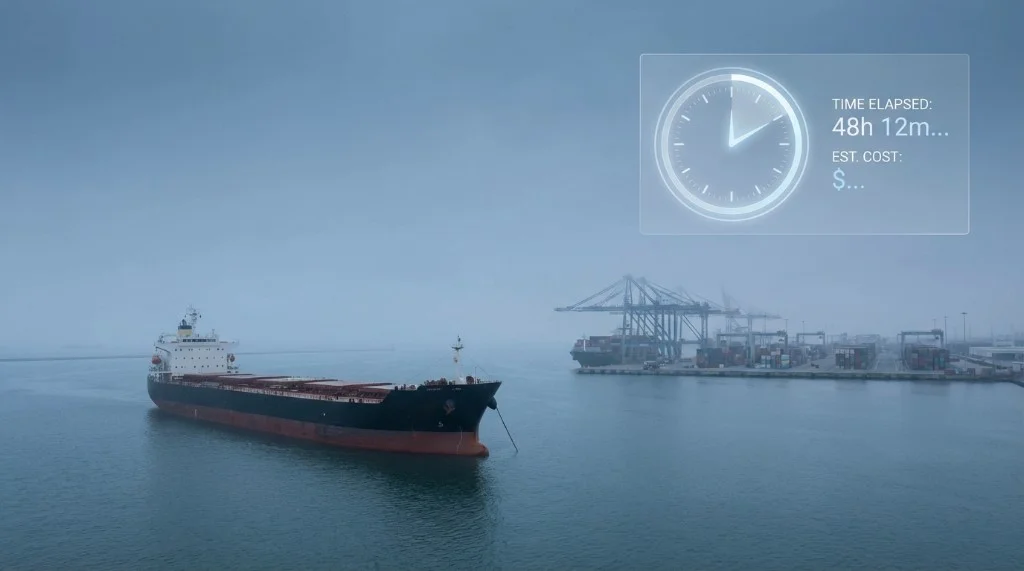
Demurrage is one of the most significant and least controlled costs in commodity trading. A single demurrage incident can cost $50,000 or more. For trading desks managing 100+ fixtures per year, demurrage exposure can reach millions annually.
Most demurrage prevention strategies focus on vessel selection, port operations, and cargo readiness. Very few focus on procurement speed — the time between cargo confirmation and vessel fixture.
That's a gap. Because procurement speed is one of the most controllable drivers of demurrage risk.
How slow procurement drives demurrage
The chain of causation is straightforward:
- Cargo becomes available at a port
- The trading desk begins freight procurement
- Email tendering takes 3–5 days to complete
- By the time a vessel is fixed, the cargo window has shifted
- The fixed vessel doesn't align with the actual cargo readiness
- The vessel waits. Demurrage accumulates.
The 3–5 day procurement cycle of email tendering is not a minor inefficiency. It's a structural driver of cargo window mismatches — and cargo window mismatches are the primary cause of demurrage.
The numbers
For a commodity trading desk running 120 fixtures per year:
- Average demurrage cost per incident: $50,000+
- Demurrage incident rate with email tendering: 8–12% of fixtures
- Annual demurrage cost: $480,000 to $720,000
With closed-bid tendering reducing procurement cycle to 8–18 hours:
- Demurrage incident rate: Reduced by 30–50%
- Annual demurrage cost: $240,000 to $504,000
- Annual demurrage savings: $216,000 to $480,000
For larger trading desks running 300+ fixtures per year, demurrage savings alone justify the cost of a procurement platform.
Scale note: The dollar figures above assume mid-size parcel demurrage (~$50K/incident). On Capesize cargoes, per-day demurrage and per-incident exposure are often multiples higher; the same percentage reduction in incidents still applies, but balance-sheet impact scales with vessel class and CP terms.
Why procurement speed matters more than vessel selection
Most demurrage prevention efforts focus on vessel selection — choosing vessels with better ETA certainty, faster loading rates, and lower demurrage risk profiles.
Vessel selection matters. But it matters less than procurement speed.
A perfectly selected vessel fixed 5 days after cargo confirmation is more likely to cause demurrage than a good vessel fixed 12 hours after cargo confirmation.
The reason: cargo windows are dynamic. Port congestion changes. Cargo readiness shifts. Loading schedules move. A vessel fixed 5 days in advance is fixed against a cargo window that may no longer exist by the time the vessel arrives.
A vessel fixed 12 hours after cargo confirmation is fixed against the actual, current cargo window.
Procurement speed is the most direct lever for reducing cargo window mismatches — and cargo window mismatches are the most direct driver of demurrage.
The procurement speed problem in email tendering
Email tendering is structurally slow. The process:
- Draft tender email with cargo specifications (30–60 minutes)
- Send to multiple brokers and wait for responses (4–24 hours)
- Follow up with non-responsive brokers (1–2 hours)
- Manually consolidate responses into a comparison spreadsheet (2–3 hours)
- Evaluate and award (1–2 hours)
- Confirm award and document decision (30–60 minutes)
Total: 3–5 days, 6–12 hours of admin time
Closed-bid tendering compresses this to 8–18 hours total, with 1–2 hours of admin time. The platform handles invitation, collection, consolidation, and comparison automatically.
Measuring the impact
Bench Energy's clients have measured the impact of switching from email to closed-bid tendering on demurrage:
- 30–50% reduction in demurrage incidents
- Average procurement cycle reduced from 3–5 days to 8–18 hours
- Cargo window alignment improved significantly
- Demurrage savings of $216,000 to $480,000 annually for mid-sized trading desks
The compounding effect
Demurrage prevention has a compounding effect that goes beyond direct cost savings.
Reduced demurrage improves counterparty relationships — sellers and buyers experience fewer delays and disruptions. It improves vessel relationships — owners are more willing to offer favorable rates to charterers with low demurrage records. And it reduces the internal admin burden of demurrage claims management.
The full value of procurement speed is larger than the direct demurrage cost reduction.
Five ways to accelerate freight procurement
Procurement speed is not a single variable — it is the sum of multiple process steps, each of which can be optimised independently.
1. Pre-qualify your broker panel. Maintain a standing panel of 15–20 pre-vetted brokers with confirmed capabilities for your regular routes and commodity types. Pre-qualification means verifying each broker's vessel access, route expertise, financial standing, and response reliability before tenders begin. When a cargo becomes available, you should be able to issue invitations within minutes — not spend hours identifying and vetting potential brokers.
2. Standardise offer format. The single largest time sink in email tendering is offer consolidation — converting five different email formats into a comparable view. Standardise what you require from brokers: rate (specifying basis — per tonne, lump sum, or worldscale), vessel name and IMO number, vessel specifications, ETA at load port, laycan window, demurrage and despatch terms, and technical compliance confirmation. A structured format eliminates interpretation risk and enables instant comparison.
3. Set 24-hour response deadlines. Open-ended tender windows are the primary cause of procurement drag. Set explicit deadlines: brokers have 24 hours to submit offers. Non-responsive brokers are excluded from the comparison. This compresses the procurement cycle and creates urgency that produces genuine market-rate pricing. Most brokers can source and price a fixture within 4–8 hours; a 24-hour window is generous.
4. Automate comparison. Manual comparison of freight offers in spreadsheets introduces errors, consumes time, and delays decisions. Automate the comparison step using a platform that ingests structured offers and generates a side-by-side comparison table — covering rate, vessel, ETA, laycan, technical compliance, and demurrage terms. The comparison should be available the moment the deadline closes, not two hours later.
5. Delegate award authority. Many trading desks require senior approval for freight awards, adding 12–24 hours to the procurement cycle. Establish clear delegation: for fixtures below a defined threshold (e.g. $75,000), the chartering operator can award directly. For fixtures above the threshold, pre-approve decision criteria so that the senior review is a confirmation, not a re-evaluation. Decision authority is the most underappreciated bottleneck in procurement speed.
Demurrage by commodity type
Demurrage costs vary significantly by commodity, reflecting differences in vessel type, loading complexity, and port infrastructure:
| Commodity | Typical demurrage cost per incident | Key drivers |
|---|---|---|
| Coal | $40,000–$60,000 | Port congestion at major loading terminals (Newcastle, Richards Bay, Qinhuangdao); weather delays; draft restrictions |
| Iron ore | $50,000–$80,000 | Capesize vessel rates; limited berth availability at major ports (Hedland, Tubarao); tidal restrictions |
| LNG | $100,000–$200,000 | Specialised vessel costs; terminal scheduling rigidity; boil-off penalties; long-haul voyage sensitivity |
| Grain | $30,000–$50,000 | Seasonal harvest congestion; fumigation delays; multi-grade cargo segregation; weather sensitivity at loading |
| Chemicals | $25,000–$45,000 | Tank cleaning requirements; cargo compatibility checks; regulatory inspection delays; parcel lot complexity |
LNG demurrage is the most expensive on a per-incident basis, but coal and iron ore generate the highest aggregate demurrage costs for most trading desks due to fixture volume. A coal trader running 120 fixtures per year with a 10% demurrage rate faces $480,000–$720,000 in annual demurrage — a cost that dwarfs most other operational expenses.
The ROI of procurement speed
The return on investment from faster procurement compounds across two dimensions: direct demurrage reduction and indirect rate savings.
Direct demurrage reduction. For a trading desk running 120 fixtures per year with an average demurrage cost of $50,000 per incident:
- Email tendering demurrage rate: 12% of fixtures = 14.4 incidents = $720,000 annually
- Closed-bid tendering demurrage rate: 6% of fixtures = 7.2 incidents = $360,000 annually
- Annual demurrage savings: $360,000
Indirect rate savings from procurement speed. Faster procurement produces better rates — not just through bid isolation, but through timing. A desk that can complete procurement in 12 hours can wait longer before initiating the tender, fixing vessels closer to the actual cargo window when market conditions and vessel positioning are more transparent. This timing advantage produces an additional 3–5% rate improvement beyond the 18% from bid isolation alone.
For $6 million in annual freight spend, a 3–5% additional rate saving equals $180,000–$300,000.
Combined annual ROI:
- Rate reduction from bid isolation (18%): $1,080,000
- Additional rate improvement from timing (3–5%): $180,000–$300,000
- Demurrage reduction: $360,000
- Total annual savings: $1,620,000–$1,740,000
Against a platform cost that most desks recover within 60 days, the ongoing ROI exceeds 10:1 for mid-market trading desks. For larger desks running 300+ fixtures per year, the annual savings scale proportionally — often exceeding $4 million.
Frequently asked questions
How does slow procurement cause demurrage?
Slow procurement causes demurrage by creating a timing mismatch between vessel arrival and cargo readiness. When email tendering takes 3–5 days to complete, the cargo window shifts during the procurement process — port congestion changes, loading schedules move, and cargo readiness dates adjust. The vessel fixed against outdated information arrives at a port where cargo is not yet ready, or cargo sits waiting for a vessel that was procured too slowly. This mismatch results in vessel waiting time, accruing demurrage charges of $25,000–$200,000 per incident depending on vessel type and commodity.
What is the average demurrage cost for commodity traders?
Average demurrage costs vary by commodity and vessel type. Coal demurrage typically costs $40,000–$60,000 per incident, iron ore $50,000–$80,000, LNG $100,000–$200,000, grain $30,000–$50,000, and chemicals $25,000–$45,000. For a mid-sized trading desk running 120 fixtures per year with an 8–12% demurrage incident rate under email tendering, total annual demurrage costs range from $480,000 to $720,000. Larger desks managing 300+ fixtures annually face proportionally higher exposure.
How much can faster procurement save on demurrage?
Reducing procurement cycle time from 3–5 days (email tendering) to 8–18 hours (closed-bid tendering) typically reduces demurrage incidents by 30–50%. For a mid-sized desk running 120 fixtures per year, this translates to annual demurrage savings of $216,000–$480,000. Combined with the 18% rate reduction from competitive closed-bid pricing and the additional 3–5% rate improvement from better procurement timing, total annual savings exceed $1.6 million for most mid-market commodity trading desks.
Related articles
- What Is Demurrage and How to Avoid It
- How Broker Collusion Costs Commodity Traders $1M+ Annually
- How to Reduce Freight Procurement Costs in Commodity Trading
- The Complete Freight Procurement Guide for Commodity Traders
Related: Email tendering problems · Dubai traders · Geneva traders · Singapore traders · FreightTender · Calculate demurrage savings
Request a FreightTender Demo · Calculate Your Demurrage Savings
Reduce demurrage through faster procurement
Closed-bid tendering compresses cycles to 8–18 hours. See a demo with your estimated demurrage savings.
Build your trading vocabulary
Commodity & Freight Trader's Lexicon
200+ Anki flashcards covering coal, metals, and oil trading — charter party clauses, laytime mechanics, FOB/CIF structures, price indices, and market terminology used by professional traders.