Why Commodity Traders Need Specialized Freight Tools
Key Takeaways
- How commodity freight procurement differs
- What specialized commodity freight procurement looks like
- Five requirements unique to commodity freight
- Where general platforms fail
- The cost of using the wrong tool
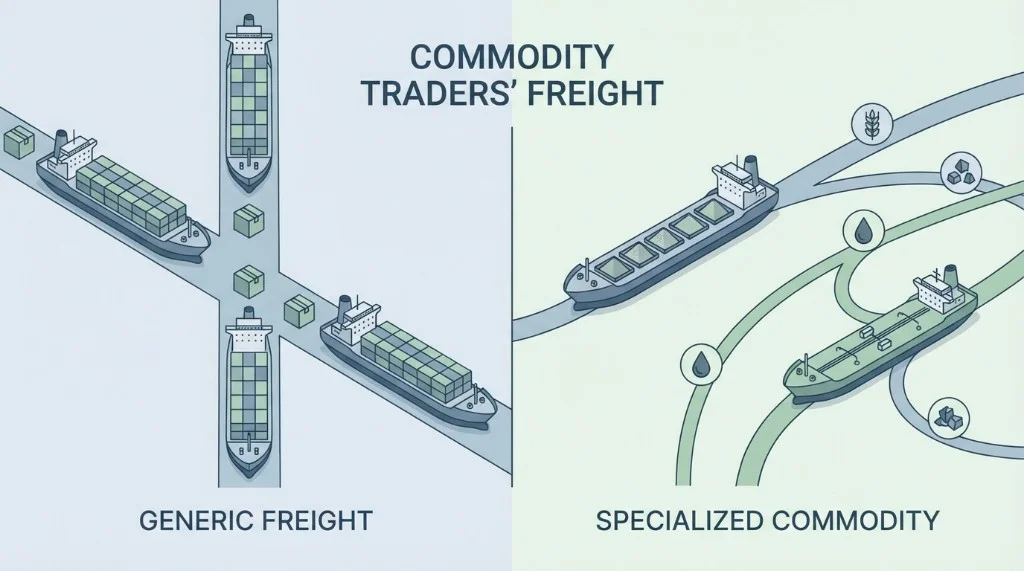
General freight procurement platforms are built for shippers: manufacturers, retailers, and distributors moving goods from factory to warehouse to store. Their problems are volume, carrier relationships, and logistics network optimization.
Commodity traders have different problems entirely.
They don't move goods from factory to store. They move bulk commodities — crude oil, refined products, metals, grains, chemicals — between trading hubs, refineries, storage terminals, and end users. Their freight is not a logistics cost to minimize. It's a trading variable that directly affects deal economics.
General freight platforms don't understand this. Commodity traders need specialized procurement tools built for their specific market structure, regulatory environment, and risk profile.
How commodity freight procurement differs
1. Freight is part of the trade, not a cost center
For a manufacturer, freight is a cost to minimize. For a commodity trader, freight is part of the deal structure. The freight rate affects the economics of the trade. A cargo that makes sense at $40,000 freight doesn't make sense at $55,000 freight.
This means commodity traders need to know freight costs before they commit to trades — not after. Procurement speed is not just about efficiency. It's about trade execution.
2. Vessel specifications are complex and critical
Commodity freight requires precise vessel specifications. API gravity, sulfur content, vessel type (VLCC, Aframax, Handymax), draft restrictions, port compatibility, heating requirements, pumping rates — these specifications are not optional. A vessel that doesn't meet technical specifications cannot load the cargo.
General freight platforms handle standardized cargo in standardized containers. Commodity freight platforms need to handle complex technical specifications across multiple commodity types.
3. Broker relationships are concentrated and interconnected
Commodity freight is brokered through a concentrated market. The same 15–30 brokers handle most commodity freight in any given hub. These brokers know each other, work together on other deals, and share market intelligence.
This concentration creates collusion risk that general freight platforms don't address. Commodity traders need procurement tools with bid isolation — closed-bid architecture that prevents brokers from seeing each other's offers.
4. Regulatory requirements are specific to commodity trading
Commodity traders operate under specific regulatory frameworks: DMCC in Dubai, FINMA in Switzerland, MAS in Singapore, and international commodity exchange requirements. These frameworks have specific documentation and audit trail requirements for procurement decisions.
General freight platforms are not built for these regulatory requirements. Commodity traders need platforms that generate audit-compliant records for every tender.
5. Demurrage risk is material
For a commodity trader, demurrage is not a minor operational inconvenience. It's a material financial risk. A single demurrage incident can cost $50,000+. For a trading desk running 100+ fixtures per year, demurrage exposure can reach millions annually.
Procurement speed is the most direct lever for reducing demurrage risk. General freight platforms optimize for cost and carrier selection. Commodity freight platforms need to optimize for procurement speed and cargo window alignment.
What specialized commodity freight procurement looks like
FreightTender is built specifically for commodity and chemical trading companies. The platform addresses each of the specific requirements of commodity freight procurement:
- Closed-bid architecture with broker isolation — eliminates collusion risk
- Standardized offer format with commodity-specific technical specifications
- Procurement cycle of 8–18 hours — reduces demurrage risk
- Immutable audit trail for DMCC, FINMA, MAS compliance
- Comparison table with rate, vessel specs, ETA, and technical compliance side-by-side
- ROI calculator for freight cost and demurrage savings
Across Bench Energy's client base managing $1.2B+ in freight:
- 18% average rate reduction compared to email tendering
- 30–50% reduction in demurrage incidents
- Complete regulatory audit trail for every tender
Five requirements unique to commodity freight
Beyond the broad structural differences, commodity freight procurement has five specific technical requirements that general platforms simply do not accommodate.
Vessel size and type constraints
Every commodity cargo has vessel requirements that go beyond simple capacity. Crude oil cargoes may require VLCCs (Very Large Crude Carriers) with specific coating types. Clean petroleum products need vessels with segregated tanks and recent cargo history that won't contaminate the load. Grain cargoes need Handymax or Supramax vessels with specific hold configurations. Chemical parcels require IMO-classified tankers with stainless steel or coated tanks rated for the specific product.
A procurement platform that treats "vessel" as a single text field cannot enforce these constraints. The result is offers on non-compliant vessels, wasted broker time, and delayed fixture — all of which increase cost and demurrage risk.
Laycan windows
Laycan (laydays/cancelling) windows in commodity trading are tight — typically 3 to 7 days. The vessel must arrive within this window or the charterer can cancel. Procurement must align with the laycan, which means the tendering process itself cannot consume the available time.
General freight platforms operate on procurement timelines of days to weeks. Commodity freight procurement must complete in hours, with offers that include specific ETAs validated against the laycan window. A platform that cannot filter and rank offers by laycan compliance is not fit for purpose.
Port draft limits
Many commodity loading and discharge ports have draft restrictions that limit the size of vessel that can call. Ras Tanura, Fujairah, Immingham, Santos, and dozens of other commodity ports have specific maximum drafts that vary by berth and tidal condition. A VLCC that cannot load to full capacity due to draft restrictions changes the economics of the entire trade.
Procurement platforms must capture draft restrictions as structured data, not free text, and automatically flag offers where the proposed vessel's loaded draft exceeds port limits. General logistics platforms have no concept of this requirement.
Cargo segregation
Chemical and clean products traders frequently need to ship multiple grades on a single vessel. This requires cargo segregation — separate tanks, separate pumping systems, and sometimes separate heating circuits. The vessel must have the right number of segregations, the right tank coatings, and documented compatibility with each product grade.
A procurement platform that cannot capture segregation requirements and validate them against vessel specifications will produce offers that fail at the operational stage. The cost of discovering a segregation problem after fixture is orders of magnitude higher than catching it during tendering.
Insurance and P&I requirements
Commodity traders and their financiers require vessels to carry specific insurance coverage: hull and machinery, P&I (Protection and Indemnity) club membership, and often additional war risk coverage for certain routes. Major oil companies and commodity houses maintain approved vessel lists based partly on P&I club standing.
A vessel offered at an attractive rate but without adequate P&I coverage — or with a club not recognised by the trader's counterparties — cannot be fixed. Procurement platforms must capture insurance and P&I details as structured fields so that non-compliant offers are identified before, not after, the award decision.
Where general platforms fail
General freight and logistics platforms were not designed with commodity trading in mind. Their limitations become apparent quickly when commodity traders attempt to use them for bulk and tanker freight.
No cargo-specific fields
General platforms capture origin, destination, weight, and sometimes commodity type as free text. They do not have structured fields for API gravity, sulphur content, flash point, IMO classification, tank coating requirements, or previous cargo compatibility. Without structured data, offers cannot be automatically validated against cargo requirements, and comparison across brokers is manual and error-prone.
No laytime calculation
Laytime — the time allowed for loading and discharging — is a critical commercial term in commodity freight. It determines when demurrage begins to accrue. General platforms have no concept of laytime, no fields for loading/discharge rates, and no mechanism for calculating allowed laytime against vessel specifications. Traders are left to manage this in separate spreadsheets, creating data silos and reconciliation errors.
No demurrage tracking
Demurrage is the single largest source of unexpected cost in commodity freight. General platforms do not track demurrage exposure at the tender stage, do not flag offers with tight ETAs that increase demurrage risk, and do not provide post-fixture demurrage monitoring. The absence of demurrage visibility at the procurement stage means traders are making award decisions without understanding the full cost of each offer.
No regulatory compliance per jurisdiction
DMCC, FINMA, and MAS each have specific requirements for procurement documentation. General platforms produce generic audit logs — if they produce any at all — that do not meet the specific evidentiary requirements of commodity trading regulators. Traders using general platforms must build their own compliance documentation layer, which is expensive, fragile, and frequently incomplete.
The cost of using the wrong tool
The financial impact of using a general platform — or worse, email — for commodity freight procurement is quantifiable.
Rate overspend: 12% on average. Without genuine bid isolation and structured comparison, commodity traders pay a premium on freight rates. Across Bench Energy's client base, traders switching from email or general platforms to closed-bid tendering see an average 12% reduction in freight rates. For a desk spending $7.5 million annually on freight, that is $900,000 in savings.
Demurrage: 3x more incidents. Slow procurement cycles — whether caused by email chains or platforms not optimised for commodity freight timelines — directly increase demurrage exposure. Trading desks using non-specialised tools experience approximately three times more demurrage incidents than those using purpose-built commodity freight platforms. At $50,000–$80,000 per incident and 50–100 fixtures per year, this translates to $216,000–$480,000 in avoidable demurrage annually.
Administrative overhead: 40+ hours per month. Freight managers using email or general platforms spend an estimated 40 hours per month on manual tasks that a specialised platform automates: consolidating offers into spreadsheets, chasing broker responses, reformatting data for comparison, building compliance documentation, and reconciling fixture details. That is a full working week every month spent on process rather than decision-making.
Compliance exposure: unquantifiable until it materialises. The cost of a compliance failure — a DMCC audit finding, a FINMA enforcement action, or an MAS investigation — is difficult to predict but potentially severe. Fines, reputational damage, and trading licence risk are all on the table for commodity traders who cannot demonstrate robust procurement controls.
How to evaluate freight procurement platforms
Not every platform marketed as "freight procurement" is suitable for commodity trading. When evaluating platforms, commodity traders should apply a specific checklist.
- Closed-bid architecture: Does the platform enforce true bid isolation? Can brokers see each other's participation, offers, or activity? If the platform allows any visibility between brokers, it does not provide genuine competition.
- Cargo-specific structured fields: Does the platform have fields for vessel type, draft, tank coatings, IMO classification, cargo segregation, P&I club, and other commodity-specific requirements? Free-text fields are not sufficient — structured data is necessary for automated validation and comparison.
- Immutable audit trail: Is every action — invitation, offer submission, modification, award — logged with a timestamp and user identity? Can the log be exported in a format suitable for DMCC, FINMA, or MAS compliance reviews? An audit trail that can be edited or deleted is not an audit trail.
- Regulatory compliance features: Does the platform generate compliance-ready documentation per jurisdiction? Does it support five-year record retention? Does it produce exportable reports formatted for specific regulatory frameworks?
- TMS and CTRM integration: Does the platform integrate with the trader's existing systems — trade and risk management (CTRM), transport management (TMS), and accounting? Standalone tools that require manual data re-entry create inefficiency and data integrity risk.
A platform that meets all five criteria is built for commodity trading. A platform that meets three or fewer is a general logistics tool with a commodity marketing layer.
Frequently asked questions
What is specialized freight procurement?
Specialized freight procurement is a structured tendering process designed for commodity and chemical trading companies. Unlike general logistics platforms, it incorporates closed-bid architecture, cargo-specific technical fields (vessel type, draft limits, cargo segregation), broker isolation to prevent collusion, immutable audit trails for regulatory compliance, and integration with CTRM and TMS systems. It treats freight as a trading variable rather than a logistics cost.
Why can't commodity traders use general logistics platforms?
General logistics platforms are built for containerised goods moving through supply chains. They lack cargo-specific fields for vessel type, draft restrictions, and heating requirements. They have no laytime calculation, no demurrage tracking, no broker isolation, and no compliance features for DMCC, FINMA, or MAS regulations. Commodity traders using general platforms typically overspend by 12% on freight and experience three times more demurrage incidents than those using specialised tools.
How much does poor freight procurement cost?
Poor freight procurement costs commodity traders an average of 12% in rate overspend, three times more demurrage incidents (at $50,000+ per incident), and approximately 40 hours per month in administrative overhead per freight manager. For a mid-sized trading desk handling 100+ fixtures per year, this translates to $900,000–$1.5 million in excess freight costs, $216,000–$480,000 in avoidable demurrage, and significant compliance exposure.
Related articles
- Closed-Bid Freight Tendering: How It Works and Why It Matters
- How to Reduce Freight Procurement Costs in Commodity Trading
- Freight Tendering Best Practices for Commodity Traders
- The Complete Freight Procurement Guide for Commodity Traders
Related: Email tendering problems · FreightTender · See platform features
Built for commodity and chemical traders
Closed-bid architecture, technical specs, audit trail. Book a 15-min demo tailored to your cargo type.
Build your trading vocabulary
Commodity & Freight Trader's Lexicon
200+ Anki flashcards covering coal, metals, and oil trading — charter party clauses, laytime mechanics, FOB/CIF structures, price indices, and market terminology used by professional traders.