15 Freight Tendering Best Practices [Checklist for 2026]
Key Takeaways
- Pre-Tendering Checklist: Preparation (5 Practices)
- Tendering Execution: 5 Core Practices
- Post-Tendering Checklist: Follow-Up (5 Practices)
- Common Mistakes to Avoid
- Quick Reference: Tendering Checklist
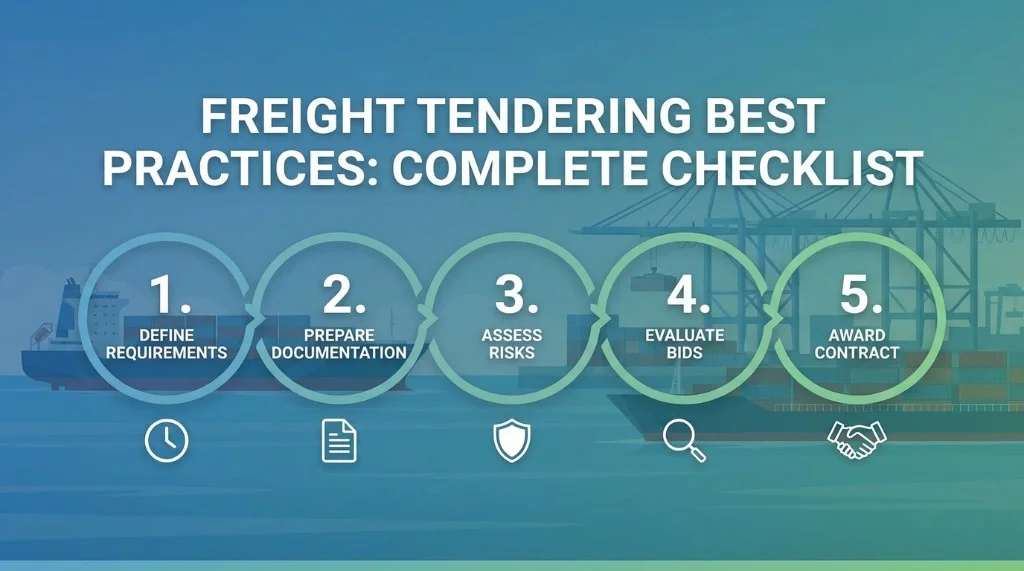
Freight tendering is both an art and a science. Get it right, and you save millions. Get it wrong, and you overpay on rates, trigger demurrage, miss compliance deadlines, and create operational chaos.
| Practice | Why it matters |
|---|---|
| Closed bids | Removes shared-information collusion |
| Reserve / benchmark | Stops outliers without killing competition |
| Written criteria | Defensible awards under audit |
| Deadlines | Forces commitment; cuts email drift |
The difference between a good tendering process and a bad one isn't complicated. It's about following proven best practices that the best traders in the industry use every day.
This checklist covers 15 essential practices that reduce costs, eliminate errors, and improve compliance. Use it to audit your current process and identify where you're leaving money on the table.
Pre-Tendering Checklist: Preparation (5 Practices)
Practice 1: Define Clear Tendering Parameters
Before you send out a single tender, lock down these details:
- Commodity type — Coal, metals, grain, oil? Different commodities have different shipping requirements.
- Quantity — Exact tonnage. Vague quantities ("around 20,000 tons") create disputes.
- Origin port — Specific port, not region. Port choice affects rates by 5-10%.
- Destination port — Exact port. Some ports have higher fees or longer wait times.
- Commodity specifications — For coal: thermal vs coking, moisture, ash. For metals: grade, purity. Specifications affect vessel type and freight rate.
- Loading window — Exact dates (e.g., "March 15-22, 2026"). Vague windows create scheduling conflicts.
- Discharge window — When cargo must arrive. This determines vessel speed requirements.
- Vessel type preference — Panamax, Capesize, Handymax? Some traders have vessel preferences based on port infrastructure.
Why This Matters: Vague parameters cause brokers to quote different rates for different interpretations. Clear parameters = comparable bids = accurate pricing. Create a tender template with all 8 parameters and use it for every tender.
Practice 2: Set a Reserve Price (Minimum Acceptable Rate)
A reserve price is the maximum you're willing to pay, based on market data. How to set it: (1) Check Baltic Dry Index (BDI) for your route; (2) Add 5-10% for broker commission; (3) Add 2-3% for contingency. Example: BDI $32/ton + 7% commission + 2% contingency = Reserve price $35/ton. If brokers quote above that, reject all bids and re-tender. Traders who set reserve prices pay 2-4% less.
Practice 3: Build a Broker Network (15-20 Active Brokers)
Don't rely on 5 brokers. 5 brokers = limited competition, higher rates. 15+ brokers = strong competition, 3-5% lower average rates. Identify brokers who specialize in your routes, invite them to your tendering platform, start with 5-10 and add 5-10 more over 3 months. See our guide on how to choose a reliable freight broker for detailed evaluation criteria. Best types: shipbroking houses, operator and owner desks, purpose-built dry bulk / tank tendering tools (e.g. FreightTender) — avoid confusing container-marketplaces with bulk workflow. Audit your current list; if you have fewer than 10 active brokers, add 5-10 this month.
Practice 4: Gather Market Intelligence
Before you tender, align on route curves: Baltic indices (BDI as composite plus Capesize/Panamax/Supramax route assessments as relevant), Platts/Argus where you price cargo, port congestion, open tonnage lists, geopolitical news. Sources: Baltic Exchange, Platts/Argus (subscription), port authority sites, Clarksons, Braemar. Brokers quote inflated rates when they know you don't have market data. Traders with market intelligence pay 2-3% less.
Practice 5: Document Your Historical Data
Keep a database of every freight contract: date tendered, routes, rates quoted, rate accepted, vessel type, actual demurrage, any issues. Historical data reveals which brokers quote lowest, which routes are most expensive, seasonal patterns, which vessel types have fewer delays. If you don't have historical data, start collecting now; after 6 months you'll see patterns.
Tendering Execution: 5 Core Practices
Practice 6: Use Closed-Bid Tendering (Not Open Bidding)
Open bidding: Brokers see each other's quotes and can collude. Closed bidding: Brokers submit sealed bids; they can't see others' quotes. Result: Closed bidding produces 3-5% lower rates. Closed bidding is one of the most powerful ways to reduce freight procurement costs. How it works: you set parameters and deadline; brokers submit sealed bids; tender closes; best bid wins; brokers never see each other's quotes. If you're using open bidding (email, phone), switch to closed bidding immediately.
Practice 7: Set a Strict Deadline
Use "Bids due by 2:00 PM GMT on March 15, 2026" — not "Bids due this week." Strict deadlines force brokers to respond quickly and compress procurement from 3-5 days to 8-18 hours. Best practice: set deadline 6-12 hours from tender opening.
Practice 8: Require Specific Bid Information
Don't accept vague bids. Require: freight rate (exact per ton), vessel name and type, ETA, port fees, insurance, laytime, demurrage rate, payment and cancellation terms. Vague bids hide costs (e.g. $40/ton plus $5,000 port fees). Create a bid template with all 8 data points and send it with every tender.
Practice 9: Evaluate Total Cost, Not Just Freight Rate
Wrong: compare only $40/ton vs $42/ton. Right: add port fees per ton, demurrage risk, vessel speed. Example: Bid A $40/ton + $5,000 port fees + slow vessel (high demurrage risk) vs Bid B $42/ton + $2,000 port fees + fast vessel. Bid B can win by $35,000 when demurrage at destination is factored in. Always calculate total cost.
Practice 10: Document Everything
Every tender needs an audit trail: who participated, what bids were submitted, winning bid and rationale, when freight was booked, any issues. This supports compliance, dispute resolution, continuous improvement, and fraud prevention. Documentation is also a key compliance requirement—see our compliance guide for Singapore, Dubai, and Geneva. Use a digital tendering platform that creates audit trails automatically.
Post-Tendering Checklist: Follow-Up (5 Practices)
Practice 11: Confirm Freight Immediately
Once you select a winner, send written confirmation (email or platform) with all parameters, vessel name and ETA, all fees, and get broker's written acknowledgment. Verbal confirmations create disputes.
Practice 12: Track Vessel Progress
Track departure, ocean progress, arrival, loading/unloading. Delays happen; early awareness lets you arrange alternatives, negotiate demurrage relief, adjust logistics. Use MarineTraffic, VesselFinder, port alerts, broker updates.
Practice 13: Monitor Demurrage Closely
Demurrage is your biggest cost risk. Monitor daily: how long is the vessel waiting, daily rate, who's responsible, can you negotiate relief? $30,000/day × 3 days = $90,000. Create a demurrage tracking spreadsheet and update it daily.
Practice 14: Collect Performance Data
After each shipment: final rate vs your budget ceiling, actual vs estimated demurrage, vessel performance, broker performance, any issues. This data feeds back into broker selection, route risk, and vessel reliability. After 6-12 months you can optimize the entire process.
Practice 15: Review and Optimize Quarterly
Every quarter review: average freight rate trend, demurrage per shipment, procurement cycle time, broker participation, compliance issues. Ask: Are we paying less than 6 months ago? Fewer demurrage issues? Should we add/remove brokers? Schedule a quarterly tendering review with procurement, finance, and logistics.
Common Mistakes to Avoid
- Accepting the first bid — Overpay by 5-10%.
- Ignoring port fees — Overpay by 3-5%.
- Using the same brokers every time — Pay 2-4% more.
- Vague tender parameters — Inflated quotes and confusion.
- Not tracking demurrage — Overpay by 10-20%.
- Accepting verbal confirmations — Disputes that cost thousands.
- Not using market data — Overpay by 3-5%.
Quick Reference: Tendering Checklist
Before: Define clear parameters; set budget / walk-away ceiling; identify 15+ brokers; gather market intelligence; review historical data.
During: Use closed-bid process; set strict deadline (6-12 hours); require specific bid info; evaluate total cost; document all bids and rationale.
After: Send written confirmation; track vessel daily; monitor demurrage; collect performance data; review quarterly.
Key Takeaways
- Preparation (parameters, market data, broker network) drives 30-40% of savings.
- Closed bidding beats open bidding — 3-5% lower rates.
- Total cost beats headline rate — factor in port fees, demurrage risk, vessel speed.
- Speed saves money — compress procurement to 8-18 hours.
- Data drives decisions — historical data reveals optimization opportunities.
- Audit trails prevent disputes.
- Quarterly reviews keep you sharp.
Follow these 15 practices and you'll reduce freight costs by 25-40% while eliminating errors and compliance issues. Traders who implement all 15 save 40-60%; those who implement 5-7 save 15-25%.
Next Steps
Audit your current process; start with the biggest gaps (e.g. switch to closed bidding for 3-5% immediate savings); build your broker network to 15+; set up demurrage and performance tracking; schedule quarterly reviews.
Related: Complete Guide to Freight Procurement · How to reduce freight procurement costs · How to choose a reliable freight broker · Email tendering problems · Dubai · Geneva · Singapore · FreightTender · Request demo
Implement the full 15-practice checklist
Bench Energy automates closed-bid tendering, reserve pricing, broker network, and audit trail. See how it works.
Build your trading vocabulary
Commodity & Freight Trader's Lexicon
200+ Anki flashcards covering coal, metals, and oil trading — charter party clauses, laytime mechanics, FOB/CIF structures, price indices, and market terminology used by professional traders.