Negotiate Freight Rates: 8 Tactics for Volatile Markets
Key Takeaways
- Understanding Freight Market Cycles
- 8 Negotiation Tactics for Lower Freight Rates
- Negotiation by Market Phase
- Key Takeaways
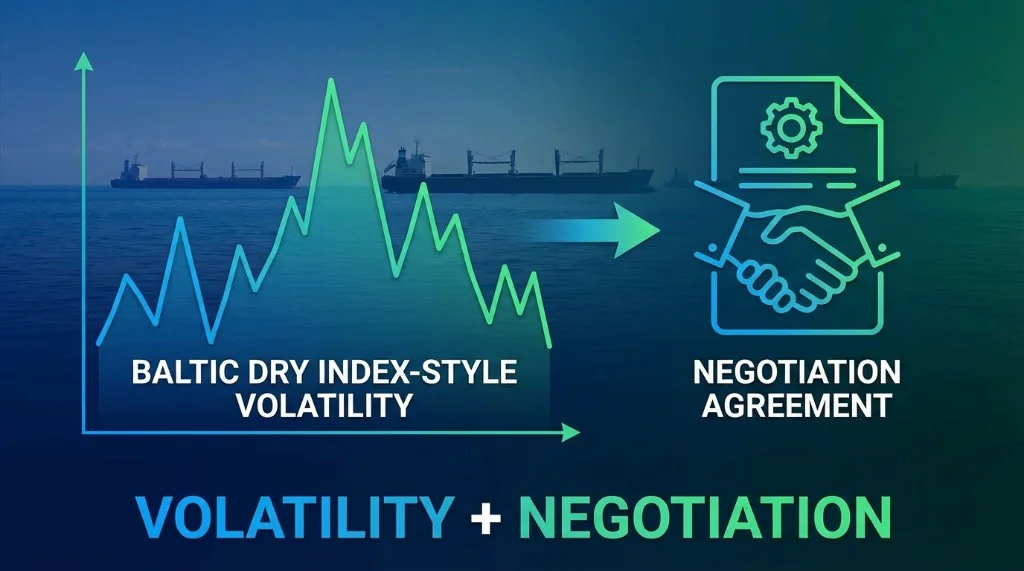
Freight curves can move 30–40% in a month on the same route. For commodity traders that creates risk (locking in high numbers) and optionality (pressing when lists are long). This guide is a tactical checklist—timing, competition, and total cost—not a primer on what BDI measures.
Understanding Freight Market Cycles
Phase 1: Trough — Route indices at lows, abundant tonnage, brokers willing to sharpen. Best: lock period/COA when credit checks clear. Phase 2: Recovery — Indices rising, lists tightening. Best: medium-term cover before peak. Phase 3: Peak — Indices high, vessels scarce. Best: draw on earlier cover, minimise spot. Phase 4: Decline — Indices off. Best: short fixtures, avoid new longs. Identify phase via Baltic route curves (balticexchange.com), 12m/3y context, orderbook, macro (e.g. steel / tonne-mile drivers).
8 Negotiation Tactics for Lower Freight Rates
Tactic 1: Time Your Tenders Strategically
Best: Monday–Tuesday, mid-month, after your route index has softened (e.g. 5%+ move in the relevant Capesize/Panamax assessment), Jan–Feb, August. Worst: end of month, pre-holidays, post-disruption panic, Chinese demand spikes. Illustrative: same cargo, same route — tender dated 15 March at $48/t vs 28 March at $43/t after a two-week slide in the applicable Baltic route curve (not noise — the index moved with open tonnage). That $5/t × 20,000 t = $100,000 on a Handymax/Supramax parcel. Scale: at Capesize volumes (~150,000 t), the same $5/t = $750,000.
Tactic 2: Use Published Curves as Your Anchor
Check the route-specific Baltic assessment (and cargo-specific adjustments), add commission and lump-sum conversions as needed, set a budget / walk-away ceiling — not a seller’s "reserve" (that term is a floor in auction language). When brokers quote above the curve, cite the published level. Desks that anchor awards to indices pay 2–4% less.
Tactic 3: Create Genuine Competition
Invite 15–20 brokers, closed-bid, 6–12 hour deadline. Open bidding, five brokers: $46/t; closed, 15 brokers: $41/t → $100,000 on 20,000 t; same spread on 150,000 t Capesize = $750,000. Market data also helps you choose reliable brokers who quote honest rates.
Tactic 4: Offer Volume Commitments
"We ship 8-10 Panamax cargoes/year on this route; if you offer 3-4% below spot we'll commit 6 cargoes annually." Get 3-5% discount and priority access when tight. Best for predictable, recurring routes.
Tactic 5: Negotiate in Market Troughs
When route indices sit at 12-month lows: sign 6–12 month COAs or period deals at current levels with a cap (e.g. freight won’t exceed index + X%). Example: lock time-charter equivalent at $15,500/day when the curve implies $15,000; three months later the market is $22,000 → meaningful savings versus spot — but trough counterparties are often the weakest owners. Before locking long tenor, run the same credit / performance screening you would on any major counterparty: financials, P&I club, arrest history, fleet age. A cheap long-term fixture with an owner that later goes bust is not a win. One long-term deal with a stressed counterparty can wipe out years of freight savings.
Tactic 6: Separate Freight from Ancillary Costs
Break down: freight, port fees, demurrage rate, despatch, insurance, fuel, canal fees. Negotiate each. $42/t all-in → $40.50/t = $30,000 on 20,000 t; on 150,000 t Capesize the same $1.50/t = $225,000.
Tactic 7: Use Alternative Routes as Leverage
If cargo can ship via multiple routes, use as leverage. "I can source from South Africa at $36/ton all-in. Match or beat for Colombian?" Only use alternatives you can execute.
Tactic 8: Build Relationships for Tight Markets
When vessels scarce, owners prioritize clients who pay on time, don't dispute legitimate demurrage, give volume, treat brokers professionally. In 2021 spike, strong-relationship traders secured $45,000/day when spot was $65,000/day → $600,000 saved on one cargo.
Negotiation by Market Phase
| Phase | Best Tactics | Avoid |
|---|---|---|
| Trough | Long-term contracts, volume deals | Spot-only |
| Recovery | Medium-term fixtures | Waiting for peak |
| Peak | Use existing contracts, minimize spot | New long-term |
| Decline | Maximize spot, short fixtures | Long-term contracts |
Key Takeaways
- Know your market phase—route indices tell you spot vs lock-in.
- Use published curves as anchor—never negotiate without a market level.
- Create genuine competition—15+ brokers, closed-bid.
- Time tenders—Monday vs Friday can mean $3-5/ton.
- Negotiate in troughs—long-term at lows saves millions when rates spike.
- Break down total cost—negotiate freight, port fees, demurrage separately.
- Build relationships—in tight markets worth more than any tactic.
Reducing demurrage is another major lever—see our complete demurrage guide. Master these 8 tactics and you'll consistently pay 10-20% below market average.
Related: Complete Guide to Freight Procurement · Reduce freight costs · Best practices · Demurrage guide · Compliance · FreightTender · Request demo
See How FreightTender Automates Competitive Freight Negotiation →
Run competitive tenders in any market
Closed-bid tendering with 15+ brokers and BDI-based reserve pricing. FreightTender automates the process.
Build your trading vocabulary
Commodity & Freight Trader's Lexicon
200+ Anki flashcards covering coal, metals, and oil trading — charter party clauses, laytime mechanics, FOB/CIF structures, price indices, and market terminology used by professional traders.