Once on Demurrage, Always on Demurrage — Unless You Know Where to Look
Key Takeaways
- Four categories of error that appear systematically
- The 90-day clock and why most disputes are never filed
- What The Eternal Bliss decided and why it matters
- Related articles
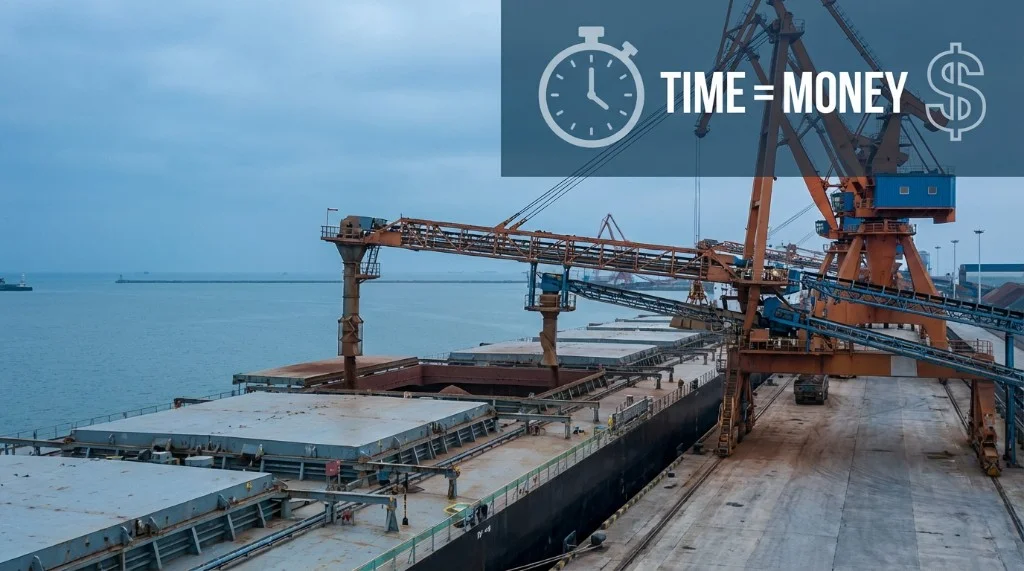
The maxim "once on demurrage, always on demurrage" is one of the oldest principles in English shipping law. Its practical effect: once laytime expires, no exception clause stops the demurrage clock unless the charter party explicitly extends that exception to the demurrage period — not just to laytime.
Most charterers do not read their exception clauses carefully enough to know whether they do.
The gap between what your charter party says and what a shipowner's laytime statement claims is where the money is. On a $500K annual demurrage spend, 20–30% of invoiced claims contain a recoverable error — not because shipowners are acting in bad faith, but because statement-of-facts calculations are done quickly, port agent records are imprecise, and charterers rarely challenge the arithmetic.
Four categories of error that appear systematically
Free pratique and the NOR validity problem
Notice of Readiness is only valid when tendered by a vessel that has arrived at the port and is ready in all respects to load or discharge. "Ready in all respects" includes having received free pratique — the health clearance from port authority.
At anchorage-heavy ports — Qinhuangdao, Paradip, Newcastle during peak season — vessels routinely tender NOR before clearing pratique, sometimes 12–18 hours before. Shipowners' statements start the laytime clock from the invalid NOR. The valid clock starts from free pratique, or from berthing if the charter party contains WIBON (Whether In Berth Or Not) language.
Check the free pratique timestamp against the NOR timestamp on every fixture at these ports. The difference in laytime calculation can be significant.
Gear breakdowns counted as laytime
If loading or discharge is interrupted because of vessel equipment failure — crane malfunction, conveyor breakdown, hatch cover seal issues — that time is typically not charterer's fault and should not count as laytime. Whether it does depends on your charter party language. BIMCO Gencon standard form does not automatically exclude vessel equipment failure from laytime; you need an express clause.
If you have that clause and the port agent timesheet records the stoppage with its cause, the dispute is straightforward. If the timesheet records "operations ceased" without cause notation, you are disputing a fact rather than a calculation. Commission your port agent to record cause and duration of every stoppage, not just duration.
Weather exclusions that do not extend to demurrage
The "once on demurrage, always on demurrage" principle applies directly here. If your charter party contains a weather working days clause that is limited to laytime and does not explicitly extend to demurrage, rain stoppages during the demurrage period are not excluded. You cannot dispute them.
If the WWD clause does extend to demurrage — and some do — then rainfall stoppages after laytime expiry are recoverable, but only if you have the evidence. Port authority rainfall records, port agent daily reports, and master's weather logs are the contemporaneous documents that support the dispute. Reconstruct them after the fact and you lose the argument.
Reversible laytime and the back-to-back calculation
On voyage charters covering both load and discharge ports, charter parties sometimes allow laytime to be calculated on a reversible basis: time saved at the load port offsets demurrage at the discharge port. Shipowners' statements frequently calculate each port separately, ignoring the reversibility provision, because it requires the charterer to raise it.
If your charter party contains a reversible laytime clause, run the combined calculation on every fixture before paying any demurrage invoice. The arithmetic is not complex; the discipline of doing it consistently is.
The 90-day clock and why most disputes are never filed
BIMCO standard charter parties impose a 90-day limitation on demurrage claims from the date of final discharge. Some charter parties are shorter — 30 or 60 days. Miss the deadline and the claim is time-barred regardless of its merits.
The same limitation applies to your counter-claims and disputes. If you receive a demurrage invoice and do not formally respond within the limitation period, you have waived your right to dispute it — even if the statement of facts contains a calculable error.
Most desks do not have a systematic process for reviewing demurrage invoices against charter party terms within the limitation window. They pay the invoice, note the cost, and move on. The result is that recoverable errors accumulate uncontested.
The minimum viable process: assign one person per fixture to reconcile the shipowner's statement against the port agent's independent timesheet within 30 days of final discharge. Flag discrepancies. Issue a formal written counter-statement — not an email, a document — for every disputed amount above a materiality threshold you set internally. Keep the clock.
What The Eternal Bliss decided and why it matters
In K Line v Priminds (The Eternal Bliss), the Court of Appeal confirmed in 2021 that demurrage liquidates the whole of the damages arising from a charterer's failure to complete cargo operations within laytime — not just some of them. The practical consequence: if a shipowner wants to recover losses beyond demurrage arising from the same breach (cargo damage, additional insurance costs), they must prove a separate and distinct breach of charter, not just the laytime violation.
For charterers, this is a protective principle. If you have paid demurrage, you should not also be paying an additional cargo claim arising from the same delay — unless the shipowner can prove a separate breach. Know this when shipowners raise combined demurrage and cargo damage claims on the same fixture.
FreightTender compresses freight procurement to 6–12 hours, reducing the procurement-related demurrage that accounts for 15% of all incidents. See how it works →
Related articles
Cut procurement-driven demurrage before it hits laytime
FreightTender compresses tender cycles to 6–12 hours so cargo windows and fixtures align. Request a demo.
Build your trading vocabulary
Commodity & Freight Trader's Lexicon
200+ Anki flashcards covering coal, metals, and oil trading — charter party clauses, laytime mechanics, FOB/CIF structures, price indices, and market terminology used by professional traders.