Demurrage: $50K/Day Cost That's 80% Preventable [2026]
Key Takeaways
- Charterparty mechanics (quick recap)
- The 5 Most Common Causes of Demurrage
- How to Calculate Your Demurrage Exposure
- 6 Strategies to Eliminate Demurrage
- Demurrage by Commodity
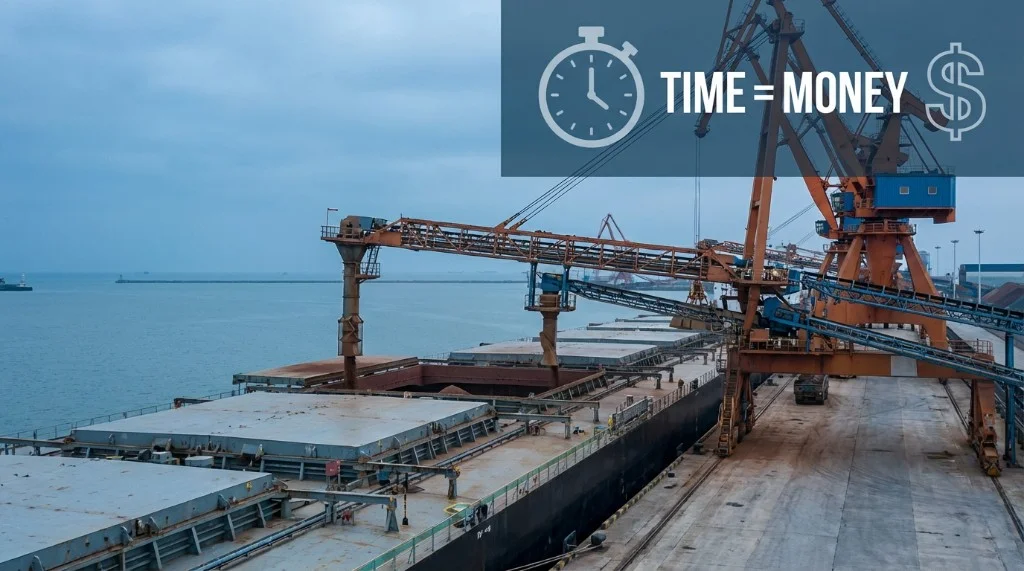
Demurrage is where many desks leak margin: it is measurable, often contractually clear — and roughly 70–80% is preventable with process (procurement speed, documentation, laytime terms, claims discipline). Typical orders of magnitude: Capesize $35K–$55K/day, Panamax $20K–$35K, smaller bulk $12K–$20K. Below we focus on causes, exposure math, and six levers — not a first-principles lecture on charterparties.
Agreed loading/discharging window — exceptions matter.
Penalty rate after laytime expires — often uncapped.
Rare bonus for finishing early — check CP wording.
Charterparty mechanics (quick recap)
Everyone on the desk should agree when laytime starts (NOR, berthing, SHINC/SHEX), how interruptions count (weather, strikes), and who bears delay — before the vessel is on the hook. That clarity drives negotiation and disputes; the refresher box above is the crib sheet.
The 5 Most Common Causes of Demurrage
1. Port congestion (35%) — Vessels queue for berth. High-risk ports: Newcastle, Richards Bay, Qinhuangdao, Paradip, Santos. 2. Slow loading/discharge (25%) — Equipment breakdown, labor disputes, rain (coal/grain moisture-sensitive). 3. Documentation delays (20%) — LC not in place, customs, B/L errors, missing phytosanitary certs. One missing document can delay 24-48 hours = $30,000-$80,000. 4. Slow freight procurement (15%) — Freight booked 2 days before loading; vessel or cargo not ready. Most preventable. 5. Cargo quality issues (5%) — Failed inspection, moisture, grade mismatch; loading stops.
How to Calculate Your Demurrage Exposure
Gather 12 months of data: agreed laytime, actual load/discharge time, demurrage paid, cause. Demurrage as % of freight spend = (Total demurrage / Total freight spend) × 100. Under 3% = excellent; 3-7% = average; 7-12% = high opportunity; over 12% = critical. Identify patterns: which routes, ports, brokers, time of year.
6 Strategies to Eliminate Demurrage
Strategy 1: Speed Up Freight Procurement
Where you control freight, book no later than five days inside the loading window and run closed-bid tendering with 6–12 hour turnaround instead of 3–5 day email rounds — procurement-driven demurrage often drops 80–90%. Incoterms matter: on FOB as buyer, that is your own freight call. On CFR/CIF as seller you control the lift — early cover is still best practice to protect demurrage exposure (late nomination can be a deliberate trade-off, not an oversight). See freight tendering best practices for a 6–12 hour tender workflow.
Strategy 2: Choose Ports Strategically
Check congestion (MarineTraffic, port authority), historical waiting times, equipment capacity, labor relations. Consider alternative ports: e.g. Gladstone 1-2 days wait vs Newcastle 4-6 days in peak; rate difference $2/ton vs demurrage saving $90,000-$120,000.
Strategy 3: Prepare Documentation in Advance
Checklist: LC confirmed, customs filed, cargo inspection booked, B/L template ready, phytosanitary/quality certs, vessel nomination in writing, port agent briefed, NOR procedure agreed. Target: all documents ready 48 hours before vessel arrival. Assign one owner per shipment.
Strategy 4: Negotiate Favorable Laytime Terms
Push for SHEX (Sundays/holidays excluded), weather working days, NOR "on berthing" not "on arrival" so you don't pay while waiting for berth. Changing NOR from "on arrival" to "on berthing" at a 3-day-wait port saves 3 × $30,000 = $90,000 per shipment. Laytime negotiation is part of our guide to negotiating freight rates.
Strategy 5: Monitor Vessels in Real Time
Track departure, speed/ETA, arrival, berth availability, load/discharge progress (MarineTraffic, VesselFinder, port sites, broker updates). Early warning lets you notify buyer, prepare alternatives, pre-negotiate demurrage relief.
Strategy 6: Dispute Demurrage Claims Aggressively
Common errors: time during rain (excluded if weather working days), Sundays/holidays (if SHEX), time before valid NOR, vessel equipment breakdown, port authority delays. Keep logs, note weather, document vessel issues, compare to shipowner statement, dispute in writing within 30 days. Average recovery 15-25% of demurrage invoiced ($75,000-$125,000 on $500K annual demurrage).
Demurrage by Commodity
| Commodity | Typical Laytime | Demurrage Rate | High-Risk Ports |
|---|---|---|---|
| Thermal coal | 3-5 days | $20K-$40K/day | Newcastle, Richards Bay, Qinhuangdao |
| Coking coal | 3-5 days | $25K-$45K/day | Dalrymple Bay, Newcastle |
| Iron ore | 2-4 days | $30K-$55K/day | Port Hedland, Tubarao |
| Grain | 4-7 days | $15K-$25K/day | Santos, Paranagua, Odessa |
| Fertilizers (bulk) | 5-8 days | $12K-$20K/day | Yuzhne, Ventspils |
| Fertilizers / ammonia (pressurised) | Terminal-specific | $25K-$80K/day | Berth rules & cargo handling dominate |
| LNG (LNGC) | Cargo-specific | $100K-$250K+/day | Terminal- and charter-form-dependent |
| Chemicals (bulk liquids) | 2-5 days | $20K-$50K/day | Coated tankers, heating, STS — berth & cargo rules |
Key Takeaways
- 70-80% of demurrage is preventable.
- Speed of procurement is the biggest lever—book 5-7 days early.
- Documentation: one missing doc costs $30K-$80K; prepare 48 hours early.
- Laytime terms negotiable—SHEX, weather, NOR on berthing can save $90K+ per shipment.
- Track vessels in real time; dispute claims—15-25% have errors.
- Measure demurrage as % of freight spend.
Combined impact of all 6 strategies: 60-80% reduction in demurrage costs.
Related: Complete Guide to Freight Procurement · How to reduce freight procurement costs · Demurrage and procurement speed · Negotiate freight rates · FreightTender · Request demo
See How FreightTender Reduces Demurrage Through Faster Procurement →
Reduce demurrage through faster procurement
FreightTender compresses tendering to 6–12 hours. Book freight 5+ days before loading and cut demurrage 60–80%.
Build your trading vocabulary
Commodity & Freight Trader's Lexicon
200+ Anki flashcards covering coal, metals, and oil trading — charter party clauses, laytime mechanics, FOB/CIF structures, price indices, and market terminology used by professional traders.