Freight Procurement Guide: 6 Chapters for Traders
Key Takeaways
- Chapter 1: Reducing Freight Procurement Costs
- Chapter 2: Freight Tendering Best Practices
- Chapter 3: Choosing a Reliable Freight Broker
- Chapter 4: What Is Demurrage and How to Avoid It
- Chapter 5: How to Negotiate Freight Rates in a Volatile Market
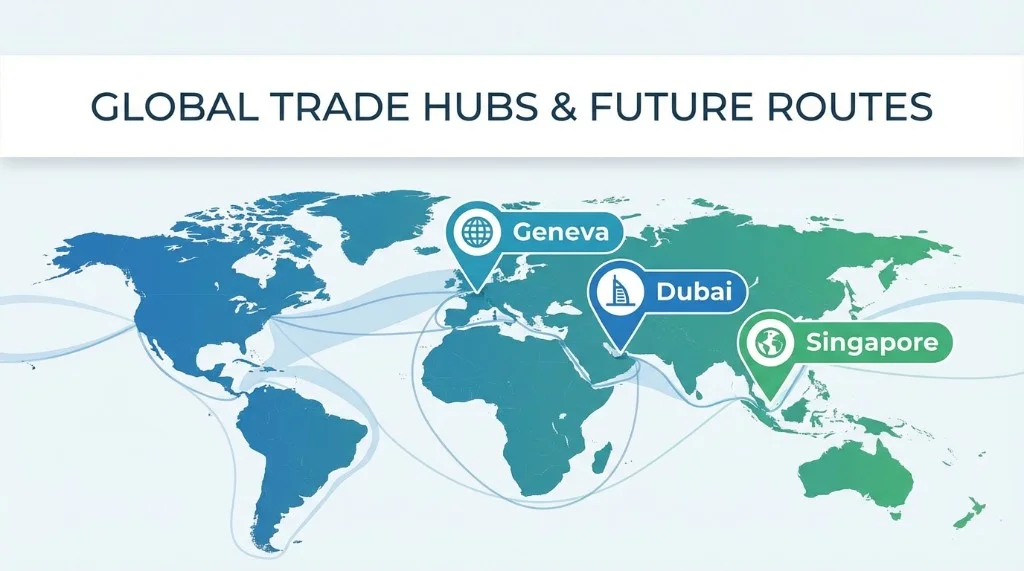
Freight procurement is one of the largest controllable costs in commodity trading. For mid-sized traders, it can represent 15–25% of deal margins. Get it wrong and you lose millions to demurrage, broker rate premiums, and compliance risk. Get it right and you cut costs 40–60%, compress cycle time from days to hours, and satisfy regulators in Singapore, Dubai, and Geneva.
Build the business case and benchmarks.
Panel, closed bids, best practices.
Operations, law, and regulators.
This guide brings together everything Bench Energy has published on freight procurement: cost reduction, tendering best practices, broker selection, demurrage avoidance, rate negotiation in volatile markets, and compliance. Each chapter is a full article you can read in order or jump to by topic.
Chapter 1: Reducing Freight Procurement Costs
Most traders still procure freight by email and spreadsheets. The result: slow cycles that trigger demurrage, rate premiums of 3–5% from information asymmetry, and manual errors that cost $10,000–$50,000 each. This chapter shows how to cut total freight costs by 40–60% using closed-bid tendering, more brokers, market data, and a 90-day implementation roadmap—with a real case study and ROI calculator.
How to Reduce Freight Procurement Costs in Commodity Trading →
Chapter 2: Freight Tendering Best Practices
Fifteen practices that separate best-in-class procurement from the rest: clear parameters, reserve pricing, a broker network of 15–20, closed-bid execution, strict deadlines, total-cost evaluation, and full documentation. Includes a checklist and the critical difference between open and closed bidding (and why closed bidding typically delivers 3–5% lower rates).
Freight Tendering Best Practices: Complete Checklist for Commodity Traders →
Chapter 3: Choosing a Reliable Freight Broker
Your broker choice directly affects rates, demurrage, and compliance. This chapter gives seven evaluation criteria (route specialization, shipowner network, pricing transparency, response time, documentation, references, technology), red flags to watch for, a scorecard, and a checklist. Plus how many brokers to use and how to run competitive tenders so you keep them honest.
How to Choose a Reliable Freight Broker for Commodity Trading →
Chapter 4: What Is Demurrage and How to Avoid It
Demurrage runs $35,000–$55,000 per day for Capesize and can consume 5–15% of annual freight spend. The good news: 70–80% is preventable. This chapter defines demurrage and laytime, lists the five most common causes (port congestion, slow ops, documentation, slow procurement, cargo issues), shows how to calculate your exposure, and gives six strategies—from speeding up procurement and negotiating laytime to disputing claims. Includes a table by commodity and vessel type.
What is Demurrage and How to Avoid It: A Guide for Commodity Traders →
Chapter 5: How to Negotiate Freight Rates in a Volatile Market
The Baltic Dry Index can move 30–40% in a month. This chapter explains the four phases of freight cycles (trough, recovery, peak, decline), when to lock in long-term vs buy spot, and eight tactics: timing tenders, using BDI as an anchor, creating real competition, volume commitments, negotiating in troughs, breaking down ancillary costs, using alternative routes, and building relationships for tight markets. Aim: pay 10–20% below market average.
How to Negotiate Freight Rates in a Volatile Market →
Chapter 6: Freight Procurement Compliance in Singapore, Dubai, and Geneva
Commodity trading is heavily regulated; freight procurement is in the spotlight. This chapter covers what matters in each hub: Singapore (MAS, AML, TBML, audit trail), Dubai (DMCC, DFSA, anti-corruption, sanctions), Geneva (FINMA, AMLA, EU sanctions, STSA). You get the five elements of a compliant process—written tenders, objective selection, full audit trail, sanctions/AML screening, retention and reporting—and a checklist by jurisdiction.
Freight Procurement Compliance in Singapore, Dubai, and Geneva →
Why Freight Procurement Matters More Than Ever
Commodity markets in 2026 face a convergence of pressures: tightening regulations, volatile freight rates (the BDI swung 45% in Q4 2025 alone), and increasing scrutiny of procurement processes by banks and compliance teams. Trading desks that still rely on email tendering are exposed on three fronts simultaneously:
- Financial exposure: Broker collusion in email tendering adds 15–25% to freight rates. For a desk spending $6M annually on freight, that's $900K–$1.5M in preventable overspend. (Read: How broker collusion works)
- Operational exposure: Email tender cycles of 3–5 days cause cargo window mismatches and demurrage incidents averaging $50,000 each. (Read: The demurrage–speed link)
- Compliance exposure: Regulators in Dubai, Geneva, and Singapore now expect documented, auditable procurement processes. Email chains don't meet that standard. (Read: Compliance requirements)
The common thread: all three exposures are solved by the same structural change — moving from open email tenders to closed-bid tendering with standardized offers and immutable audit trails.
Key Metrics: What Good Looks Like
Across Bench Energy's client base managing $1.2B+ in annual freight, the following benchmarks separate best-in-class procurement from average:
| Metric | Email Tendering | Closed-Bid Tendering |
|---|---|---|
| Tender cycle time | 3–5 days | 8–18 hours |
| Rate vs market benchmark | +15–25% | -5–10% |
| Demurrage incident rate | 8–12% of fixtures | 4–6% of fixtures |
| Admin time per tender | 6–12 hours | 1–2 hours |
| Audit trail completeness | Partial / none | 100% |
| Compliance readiness | Manual reconstruction | Automatic, exportable |
For a mid-sized desk running 120 tenders per year at $50,000 average freight cost, the total annual value of switching is $1.45M–$1.89M — combining rate savings, demurrage prevention, and admin time reduction. (See the full cost breakdown)
How to Use This Guide
Read the full guide in order for an end-to-end view, or jump to the chapter that matches your priority: costs, process, broker selection, demurrage, negotiation, or compliance. Each article links to the others where topics overlap, so you can go deeper without leaving the cluster.
Combined, these six chapters give you a single reference for freight procurement that supports both day-to-day execution and long-term strategy—and that satisfies the documentation and audit expectations of regulators and banks.
Next Steps
Bench Energy’s FreightTender platform is built for commodity traders: closed-bid tendering in 6–12 hours, 15+ brokers, BDI-based reserve pricing, and an automatic audit trail for MAS, DFSA, and FINMA. If you want to see how it works with your routes and volumes, request a demo.
Related: FreightTender · Email tendering problems · Dubai · Geneva · Singapore
See all six chapters in one place
Cost reduction, best practices, broker selection, demurrage, negotiation, compliance. The complete guide for commodity traders.
Build your trading vocabulary
Commodity & Freight Trader's Lexicon
200+ Anki flashcards covering coal, metals, and oil trading — charter party clauses, laytime mechanics, FOB/CIF structures, price indices, and market terminology used by professional traders.